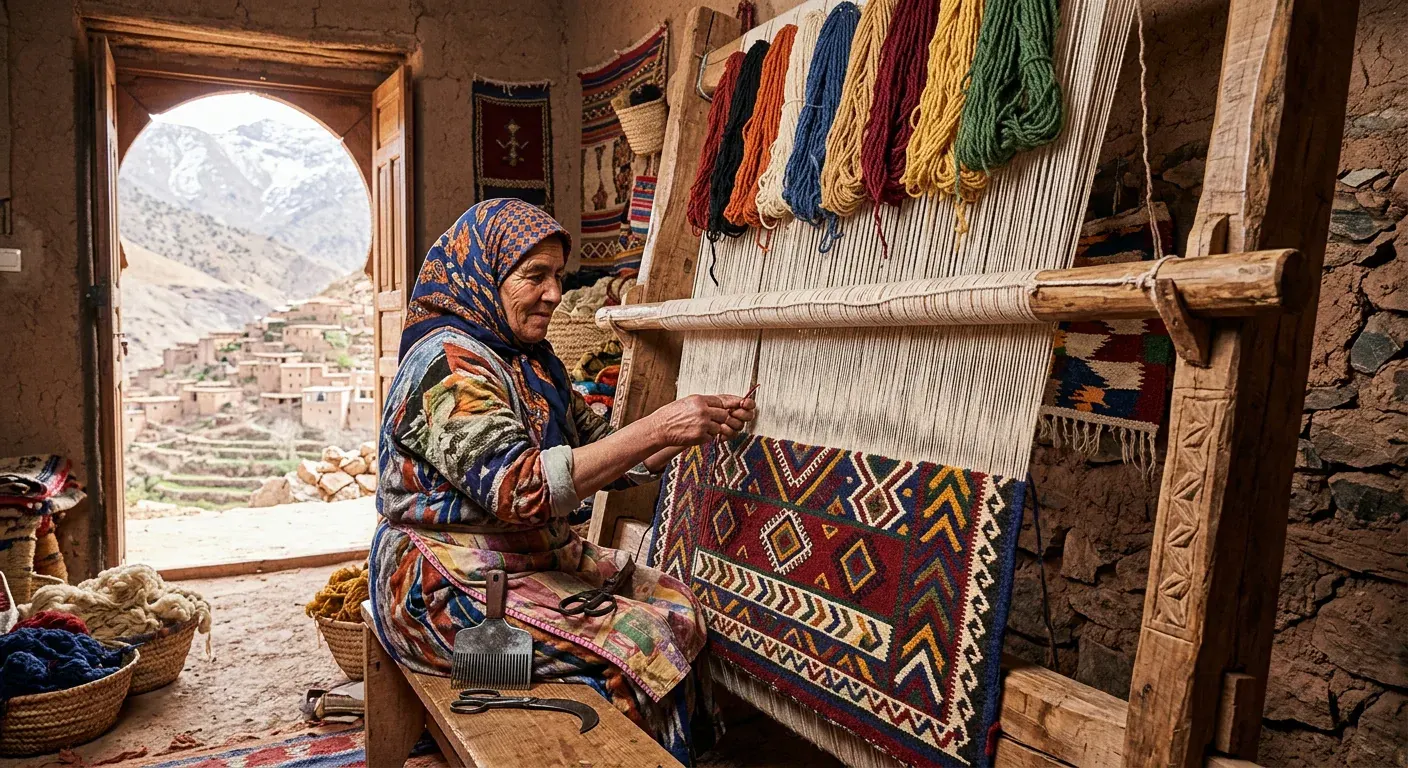
In Chefchaouen the bargaining is unhurried, and that is the whole charm of it. This is a mountain town, not a tourist gauntlet; the weaver folding a blanket across the counter has time for you, and the back-and-forth is closer to a conversation over a stool than a duel. Treat it as a courtesy and it rewards you with a fair number and, more often than not, a second pour of tea. Push too hard, or too fast, and you spoil a thing that was never meant to feel like combat. Here is how we coach our guests to handle it among the blue lanes — plainly, with real figures and a little local colour.
What the Rif sells, and why the first number floats
Chefchaouen's medina trades less in the brass and lanterns of the imperial cities and more in what the mountains make: handwoven wool blankets and striped mendil shawls, the pompom throws that hang in every doorway, jellabas spun from local wool, cloth coloured with plant dyes, goat's cheese and Rif honey from the morning market. For almost all of it, the opening figure is the start of a chat rather than a verdict. A seller quotes high because tradition expects you to answer; pay the first price and you have simply made his afternoon. None of this is trickery — it is how a wool trade older than price tags has always conducted itself.
One boundary matters. The rule covers craft stalls, not everything in town. Beyond the walls, the groceries and pharmacies of the new quarter charge what the shelf says. Within the lanes, the women's weaving cooperatives — Chefchaouen's pride — along with the argan and craft collectives marked by their official plaques, hold firm, fair prices on purpose. Unsure which kind of stall you are in? A gentle "Prix fixe?" answers it before anyone has reached for the calculator.
How the exchange actually unfolds
Strip away the romance and a Chefchaouen haggle moves through a few predictable beats:
- The opening quote lands first, usually double to quadruple the figure the seller would happily take by the end.
- Show curiosity, not hunger. Run a hand over the weave, ask where the wool came from, glance at the throw beside it. Visible longing only nudges the price upward.
- Answer with roughly half of the opening number — said warmly, never apologetically. A small smile carries it.
- He eases down, you inch up, and the two of you meet near a quarter to a third below the first ask for everyday pieces — further down again on a big blanket or a stacked carpet, where there is more give.
- If the figure sits right, shake on it. If it doesn't, drift toward the door without drama. A seller with room left will follow you out; one who is already at his floor will simply wish you well.
What things should cost in the blue city
Prices shift with season and stall, but these are sensible landing figures for the Chefchaouen medina across 2025–2026, weighted toward the Rif's woollen specialities:
| Craft | Sensible final price (MAD) |
|---|---|
| Striped mendil shawl, handwoven wool | 120–250 MAD |
| Small pompom throw / cushion cover | 150–350 MAD |
| Rif wool blanket, single bed | 400–900 MAD |
| Hand-loomed wool blanket, double / heavy | 900–2,000 MAD+ |
| Woollen jellaba, undyed or plant-dyed | 300–650 MAD |
| Natural-dyed scarf or length of cloth | 80–200 MAD |
| Small carved-cedar or olive-wood piece | 60–180 MAD |
| Jar of Rif honey or local goat cheese (market) | 40–120 MAD |
Read these as the figure in your hand at the end, not the figure you open with. When a seller starts at twice the table, aim your counter beneath it; when he starts close to it, there is little left to win and the quote is already honest.
A few words that open doors
No one expects fluent Darija, but a scrap of the local tongue tells a seller you have settled in rather than stepped off a coach. Up here in the old Spanish zone, Castilian often lands more smoothly than French:
- Bshal? — How much is it?
- Ghali bezzaf — Far too dear (carried on a grin, never a scowl).
- Imken tnaqqes chwiya? — Could you come down a touch?
- Wakha — Agreed (the word that seals it).
- La shukran — No, thank you (warm but final, your cleanest exit).
- ¿Cuánto? / muy caro — How much? / too expensive, in the Spanish many Rif sellers still speak.
French will get you everywhere too — most shopkeepers switch to it without a thought — but in Chefchaouen specifically a little Spanish is the friendlier key, a leftover of the northern protectorate that still warms a first hello.
The art of leaving — and meaning it
Stepping away is a tool, not a snub. Call the soft number after you and the seller still has slack; let you vanish into the next blue alley and he has shown you his floor. The one discipline that matters: only leave if you would genuinely be content to. Wander off, then sheepishly return to pay the first price, and you have taught that shopkeeper exactly how little your protests mean — for this visit and any future one.
And when a price is plainly fair, just take it. Grinding a weaver over twenty dirham on a scarf sours the whole exchange; the pleasure of carrying home something handmade is worth more than the coins you clawed back.
The handful of tricks still worth knowing
Chefchaouen is among the gentlest medinas in Morocco, but a few old routines linger even here:
- The friendly escort. A young local, English impeccable, offers to walk you to "the best photo spot" or a particular dye-house for nothing — then collects a fifth to two-fifths of whatever you spend in the shop he happens to deliver you to, with prices padded to match. Lean on guides booked through your guesthouse or through us instead.
- The uninvited henna. Near the kasbah square a woman may begin painting your hand before you have agreed to anything, then quote far more once the design is set and you cannot rinse it off. Only sit for henna in a shop you chose to enter.
- The creeping spice tally. A stallholder scoops a little cumin, a little ras el hanout, a little saffron-coloured something while chatting, then totals it well above what you pictured. Settle the price of each scoop before it leaves the jar.
- The "come for tea" weaving pitch. Someone presents themselves as a student wanting to practise their English and invites you up to a family workshop. The tea is real and lovely; the long, gentle blanket pitch that follows is hard to leave politely. If you want to buy wool, choose the cooperative yourself rather than following an invitation.
A good guide for your first wander through the blue medina quietly removes most of this — the souk knows the guides we work with, and the commission-hunters keep their distance from a visitor who is clearly already in good hands.
Frequently asked
Do you bargain for crafts in Chefchaouen's blue medina?
For most of the handmade pieces the Rif is known for, yes. Wool blankets and mendil shawls, the famous pompom throws, natural-dyed cloth, woollen jellabas, carved-cedar trinkets and goat-cheese-and-honey market stalls all involve some negotiation, and the first figure quoted is a starting offer rather than a settled one. The clear exception is the town's women's weaving cooperatives and a handful of plaque-marked artisan houses, where the labelled price is fixed and already fair — there, bargaining is out of place.
What is a fair counter-offer for Rif wool and blankets?
Reply to the opening number with roughly half, then drift upward until you land around a quarter to a third below where they began. A blanket weaver who has spent a fortnight at the loom expects a slower, warmer exchange than the man selling olives by the kilo, so read the craft before you read the price. One tell never fails: if the seller agrees to your first low offer without a flicker of protest, your opening was too generous.
Which words help most when bargaining in the north?
Keep it short — 'Bshal?' (how much?), 'Ghali bezzaf' (too dear), 'Imken tnaqqes chwiya?' (could you come down a touch?), 'Wakha' (agreed) and 'La shukran' (no, thank you) will see you through. Chefchaouen sits in Spain's old northern zone, so Spanish is widely understood here and often lands more naturally than French; '¿Cuánto?' and 'muy caro' work fine. Tone outranks vocabulary every time — the warmth in your face does more than the accent.
Where are prices fixed rather than negotiable?
The newer streets outside the ramparts — pharmacies, groceries, the bus-station kiosks — run on set prices. Inside the blue lanes, the certified weaving collectives run by Chefchaouen women, the argan and craft cooperatives, and the municipal produce hall all sell at marked, honest rates. If you cannot tell whether a stall expects a haggle, a quick 'Prix fixe?' settles it before anyone has invested time in the dance.
What should I watch for in the Rif medinas?
Chefchaouen is famously easy-going, but the familiar tricks still surface now and then. A stranger may offer to 'just show you the photo spots' and quietly steer you into a cousin's shop for a cut of the sale; a henna seller may start painting an unasked hand and name a price afterward; a spice vendor may bag a little of everything and tally it at the end. The rule travels well across Morocco: a favour pressed on you unrequested is rarely a favour at all.
Is it acceptable to walk off mid-haggle?
Entirely — easing toward the door is part of the choreography, not an insult. A weaver who lets you leave in silence has shown you the floor; one who calls a softer number after you has more to give. Step away gently, with a smile, and circle back later if the piece keeps tugging at you. If you were never going to buy, though, the kinder thing is not to open the negotiation at all.
Buy beautiful things, fairly
Our Rif guides know every weaver worth visiting — and what their work truly costs.
Each Chefchaouen Blue City Tours itinerary comes with souk guides we work with, who walk the blue lanes at your pace, introduce you to the women's cooperatives and cedar workshops they trust, and make sure the price you pay for a Rif blanket is the right one.
Plan your Chefchaouen visit