Why Chefchaouen Is Blue: The Blue Medina Story & Walking Guide
Chefchaouen is known the world over as Morocco's "Blue City" — a medina where walls, lanes, doors and stairways are washed in shades of blue, from pale powder to deep indigo. There is no single proven reason for the colour, and several explanations circulate side by side: a Jewish heritage said to date from the arrival of refugees from Spain, a practical belief that the blue helps keep homes cool and deters insects, and a more recent story driven by tourism, with residents repainting the lanes each year. Whatever the true origin, the result is one of the most atmospheric old towns in the country. Here is the story behind the blue and how to enjoy walking it.
The honest starting point is that nobody knows for certain why Chefchaouen is blue. Several explanations are repeated by guides and residents, and they may all hold a grain of truth. Treat the popular stories as the local lore they are rather than settled fact, and enjoy the colour for its own sake.
02History
The Jewish-heritage explanation
One widely told account links the blue to the town's Jewish community, including refugees who settled here after leaving Spain. In this tradition blue carries spiritual meaning, evoking the sky and the divine, and the practice of painting walls blue is often traced to that heritage. It remains the most frequently cited story behind the colour.
03Background
The cooling and insect theory
A more practical explanation holds that the blue wash helps keep houses cooler in the heat and may deter mosquitoes and other insects. Whether or not the effect is real, it is a common local reason given for keeping the lanes painted, alongside the simple fact that the colour is pleasant to live among.
04Background
The tourism and tradition story
Some say the blue was encouraged more recently as the town became a draw for visitors, with residents repainting walls to keep the medina vivid. Today the upkeep is part tradition, part civic pride and part livelihood, as the blue lanes are central to why people come. Many homes are refreshed with new coats each year.
05Atmosphere
Many shades, not one blue
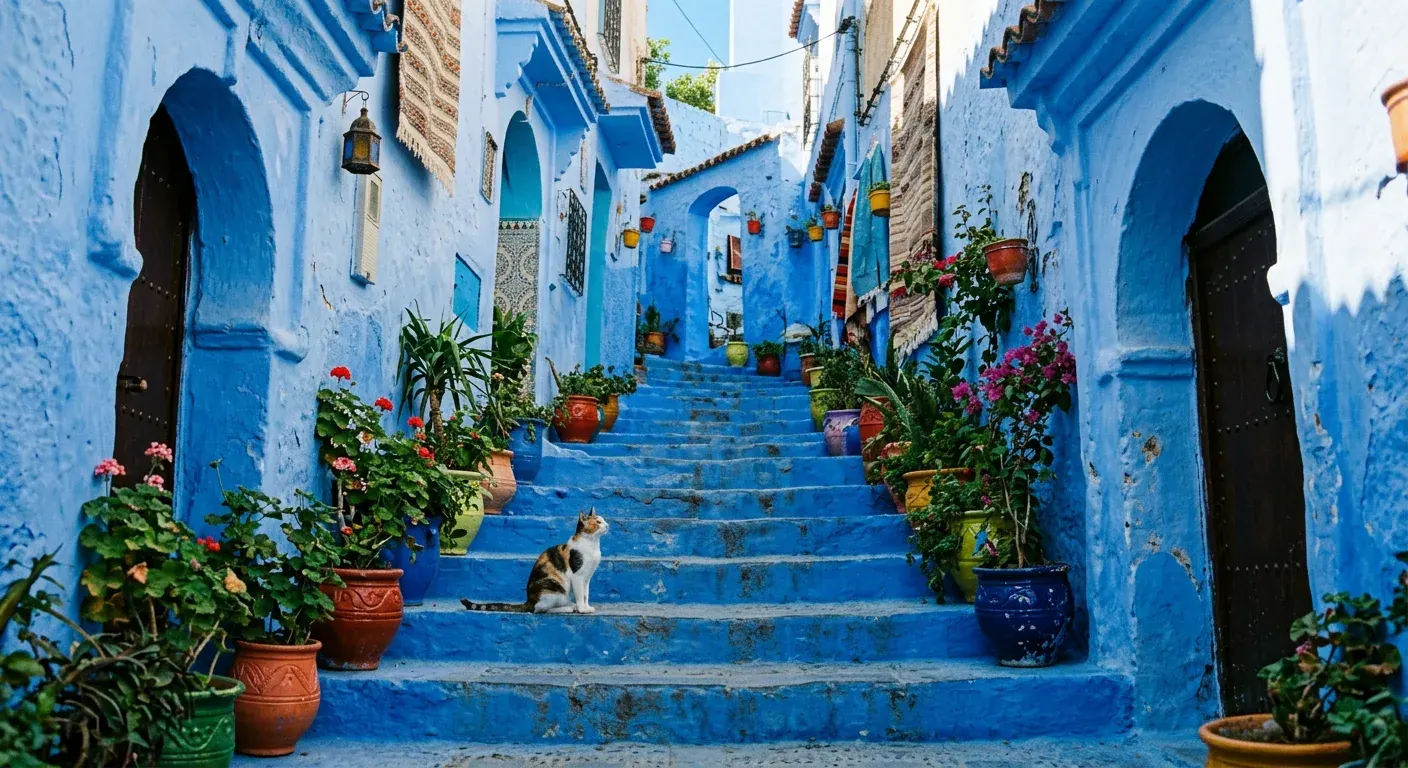
Look closely and the medina is not a single colour but a layering of blues — chalky powder tones, brighter sky shades and deep indigo around doors and steps — set off by white trim, terracotta pots and wooden doors. The way the shades shift from lane to lane is part of what makes wandering here feel endlessly varied.
06Where to walk
Where the lanes are bluest
The most intensely blue corners cluster in the upper, older parts of the medina, on the slopes above Plaza Uta el-Hammam and toward the eastern edge near the river. Wandering uphill and into the quieter side lanes, rather than the main thoroughfares, tends to reveal the deepest colour and the photogenic stairways.
07Experience
Getting pleasantly lost
The medina is small and walkable, and the best way to enjoy the blue is simply to wander without a fixed route. The lanes are a maze of steps and dead ends, but you are never far from a landmark, and getting gently lost among the blue walls is the heart of the Chefchaouen experience.
08When to go
Best light for the colour
Early morning is the calmest time, with soft light, few crowds and shopkeepers just opening up. Late afternoon brings warmer tones, while the flat light of an overcast day can make the blues look especially saturated. The harsh midday sun and the busiest hours are the least flattering for the lanes.
09Etiquette
Respect for residents
The blue lanes are people's homes, not a film set. Keep your voice down in the quiet residential streets, do not block doorways, and ask before photographing people or stepping into private courtyards. The painted steps and pots are tended by the families who live there, so treat them with care.
10Itinerary
Combining the blue walk with the sights
A wander through the blue lanes pairs naturally with the medina's set pieces: a coffee on Plaza Uta el-Hammam, a look inside the kasbah, the riverside spring at Ras el-Maa and the climb to the Spanish Mosque for a wide view over the blue rooftops. Together they make an easy, unhurried day on foot.
11Practical
Shopping among the blue
The same lanes are lined with small workshops and shops selling woven blankets, leather, wool goods and local crafts, so a blue-city stroll doubles as relaxed browsing. Prices are not fixed, and gentle bargaining is normal, so take your time and enjoy the setting as much as the buying.
Frequently asked
Why is Chefchaouen painted blue?
There is no single proven reason. The most common explanations are a Jewish heritage in which blue carries spiritual meaning, a practical belief that the blue keeps homes cool and deters insects, and a more recent tourism-driven tradition of repainting the lanes. All three stories are widely repeated locally.
Where are the bluest streets in Chefchaouen?
The deepest blue tends to be in the upper, older parts of the medina on the slopes above Plaza Uta el-Hammam and toward the eastern edge near the river. Heading uphill into the quieter side lanes, away from the main thoroughfares, usually reveals the most vivid colour and the photogenic stairways.
When is the best time to walk the blue medina?
Early morning is calmest, with soft light and few crowds, while late afternoon gives warmer tones. An overcast day can make the blues look especially saturated. Harsh midday sun and the busiest hours are the least flattering times for the lanes.
Is it polite to photograph the blue streets?
Photographing the lanes themselves is fine, but the blue streets are people's homes. Ask before photographing residents, do not block doorways or enter private courtyards uninvited, and keep noise down in quiet residential areas out of respect for the families who live there.
See it with a local
Turn this into a private Chefchaouen trip.
We'll build a private, guided plan around the experiences you care about — with a driver, hand-picked riads and a written quote in 24 hours.