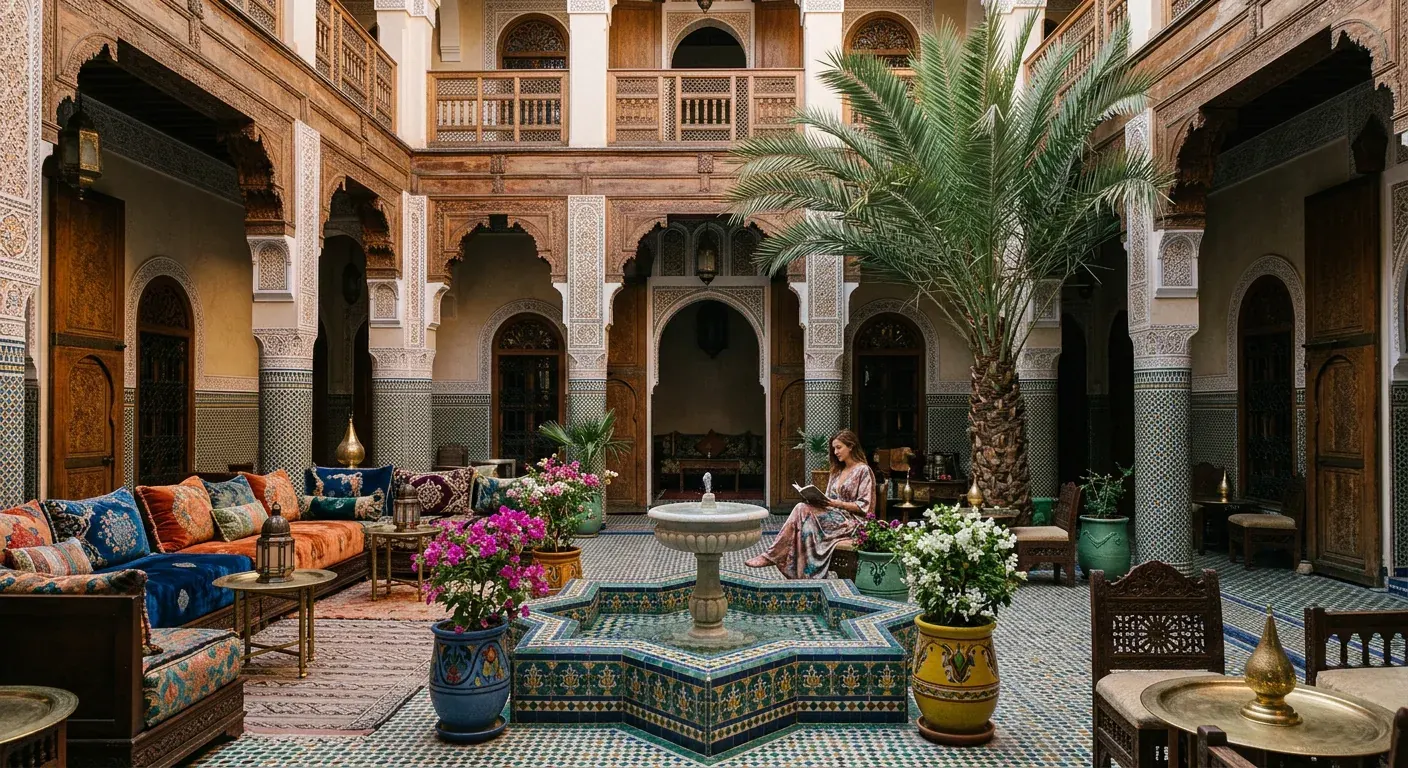
For many travellers, sleeping in a riad is the defining Marrakech experience — more memorable, arguably, than any single sight. But the word 'riad' now stretches to cover everything from a lovingly restored 17th-century merchant house to a new-build that borrowed the look and left out the soul. Knowing what to look for saves you both money and disappointment. And once you understand the riad, you also understand the smaller guesthouses of the blue city, which run on the same instinct for inward, family-scaled hospitality.
What makes a riad a riad?
A true riad is a townhouse built around an interior courtyard — the wast al-dar — usually with a central fountain or small pool, a garden of citrus and olive, and rooms set over two or three storeys around that open core. Light drops from above; the street face is plain plaster. Everything lovely is kept within.
That inward plan was deliberate: riads were private family homes, the courtyard giving them air, greenery and a social heart. Many of Marrakech's finest are 200–400 years old, raised when the Saadian and Alaouite dynasties made the city a royal capital. The details to look for — hand-cut zellige tilework, carved plaster (stucco), painted cedar ceilings, moucharabieh screens — carry centuries of craft. You meet the same hands further north too: the cedar and plasterwork of Tetouan and the Rif belong to the same tradition.
Plenty of modern 'riads' are new builds, or guesthouses that took on the courtyard shape without the old fabric. They can be excellent, but the experience differs. If a genuinely old house matters to you, ask directly about its history and look for thick walls, original tiling and hand-carved wood rather than smooth paint and imported tiles. In Chefchaouen the equivalent question is whether your dar sits in an authentic blue-medina building, lime-washed in the famous indigo, or in a newer block dressed to match.
Which neighbourhood suits which traveller?
In Marrakech, all the best riads sit inside the medina, and the quarters differ in meaningful ways:
- Mouassine & Bab Doukkala: the most characterful pocket, with the densest run of traditional riads, the Mouassine fountain and mosque, and easy reach of the dyers' souk and the Saadian Tombs. The alleys are tight and atmospheric. Best if you want full immersion.
- Riad Laarous & Kennaria: quieter and more residential, a touch further from Djemaa el-Fna but less trodden by tourists. Strong value and a more local feel. Good for returning visitors who already know the headline sights.
- North medina (near Bab el-Khemis): furthest from the bustle, but home to some of the city's most architecturally serious restored riads. Suited to those who want calm and have their own transport.
- Near Djemaa el-Fna: the most convenient spot, five minutes from the square, and also the loudest — motorbikes, vendors and music carry well into the night. Check whether your riad has a roof terrace to retreat to. (For the opposite of all this noise, the blue medina of Chefchaouen is the obvious northern antidote — quiet, walkable and car-free in its heart.)
What should you look for in a riad?
Beyond aesthetics, these are the questions worth asking before booking:
- Is it owner-managed or agent-managed? Owner-present houses tend to give better service, more useful recommendations and closer attention to upkeep.
- How many rooms does it have? Under ten feels intimate; above fifteen starts to feel hotel-like. Couples or small groups wanting privacy should look for exclusive-use buy-outs.
- Is there a plunge pool? In a Marrakech summer (June–August), with 38–42°C heat, this is less a luxury than a necessity. The cooler Rif around Chefchaouen rarely demands one.
- Are the bedrooms air-conditioned? Traditional riads stay naturally cool, but upper-floor rooms can warm up in July and August. Confirm AC in the room, not only in the common areas.
- Does breakfast look genuinely Moroccan? A photo of the breakfast table tells you a great deal about the hospitality. Look for msemen, khobz, argan oil, amlou and fresh-squeezed orange juice — not just croissants and jam.
- What is the transfer arrangement? Riads deep in the medina can't be reached by car; a good house will meet you at a nearby landmark or send a porter. Chefchaouen's blue medina is the same — arrival is by road from Tangier or Fès, then on foot — so confirm the meeting point in advance.
Where to book and how to avoid disappointment
Booking direct — by email or WhatsApp — often beats the third-party platforms on rate and gives you a line to the team before you arrive. It also lets you ask the questions above and weigh the quality of the reply.
When reading reviews, lean on those left by travellers whose priorities match yours. A solo backpacker and a couple marking an anniversary will judge the same house very differently. Hunt for notes on noise, breakfast, how willing the staff were and how any problem was handled — these tell you far more than praise for the décor.
If you would rather not research it all yourself, we work with a hand-picked set of Marrakech riads across price points that we have stayed in and vetted — and, closer to home, with the guesthouses of the Chefchaouen medina we know personally. We can match you to the right place by your dates, group size and what matters to you, then arrange the road transfers as part of a wider Morocco itinerary. See our Marrakech destination guide and private tour options for more.
Frequently asked
What exactly is a riad, and how is it different from a hotel?
A riad (from the Arabic 'riyadh', meaning garden) is a traditional Moroccan townhouse wrapped around an interior courtyard, often with a fountain, citrus trees and a plunge pool. Where a hotel is built for anonymous numbers, a riad is intimate — usually 5 to 15 rooms — with shared living space, a resident cook and staff who learn your name. The architecture faces inward by design: plain walls to the street, everything beautiful kept inside. In Chefchaouen the same idea takes a slightly humbler shape — the blue medina's guesthouses (dar and maison d'hôtes) share that inward, family-run warmth, often with a Rif-facing roof terrace in place of a grand courtyard.
Which neighbourhood is best for a riad in Marrakech?
In Marrakech you want the medina — the historic quarters of Mouassine, Bab Doukkala, Riad Laarous and Kennaria. They are walkable to the main souks, within 10–15 minutes of Djemaa el-Fna, and full of genuine medina texture. The Hivernage and Guéliz districts (the French-built new city) hold hotels but no real riads, and the feel is entirely different. For a first visit, the medina is non-negotiable — much as, in Chefchaouen, you will always want to be inside the blue-washed old town rather than the newer streets below it.
How do I find a good riad without relying on a famous name?
Look for owner-managed places that reply in a personal voice rather than corporate hotel-speak. Check that the photos show the real courtyard and rooms, not just styled mood shots. Ask plainly whether the house takes several unrelated groups at once or is reserved for your party — it shapes the whole atmosphere. Reviews that mention the host by name are the surest sign of a genuinely run house, and the same test serves you well for a guesthouse in the Chefchaouen medina.
What should a riad breakfast include?
A proper Moroccan breakfast is one of the great small pleasures of travel here. Look for msemen or beghrir (semolina pancakes), khobz (flatbread), argan oil and amlou (almond-argan paste), local honey, fresh orange juice, and mint tea or coffee. In the Rif, expect the region's own goat cheese and mountain honey on the table too. If a house offers only toast and continental bits, it is cutting corners; a full Moroccan spread is the standard anywhere worth staying.
Is it safe to stay in the medina in Marrakech?
Completely. The medina is heavily policed, with tourist police, CCTV and licensed guides well established. The tight alleys can disorient you on a first night, but your riad will send someone to meet you nearby if you get lost — just WhatsApp them. Arrange your airport or train-station transfer through the property. Chefchaouen's medina is calmer still and reached by road from Tangier or Fès, since the blue city has no airport of its own — your guesthouse will point you to a reliable driver.
How far in advance should I book a riad in Marrakech?
Good riads — especially well-regarded ones with 5–8 rooms — sell out months ahead in peak season (March–May and October–November) and over Christmas and New Year. In shoulder or low season, two to four weeks is usually enough. For a private buy-out of a small house (popular with couples or families wanting it to themselves), plan six months ahead for peak dates. The small, sought-after guesthouses of Chefchaouen book up just as quickly in spring and autumn.
Accommodation we trust
We'll place you somewhere that fits, not just somewhere with a free room.
Every place we recommend, from a Marrakech riad to a blue-medina guesthouse in Chefchaouen, has been visited by our team. We know which are genuinely quiet, which kitchens shine, which hosts go beyond the expected. Tell us your preferences and we'll match you accordingly.
Request an itinerary