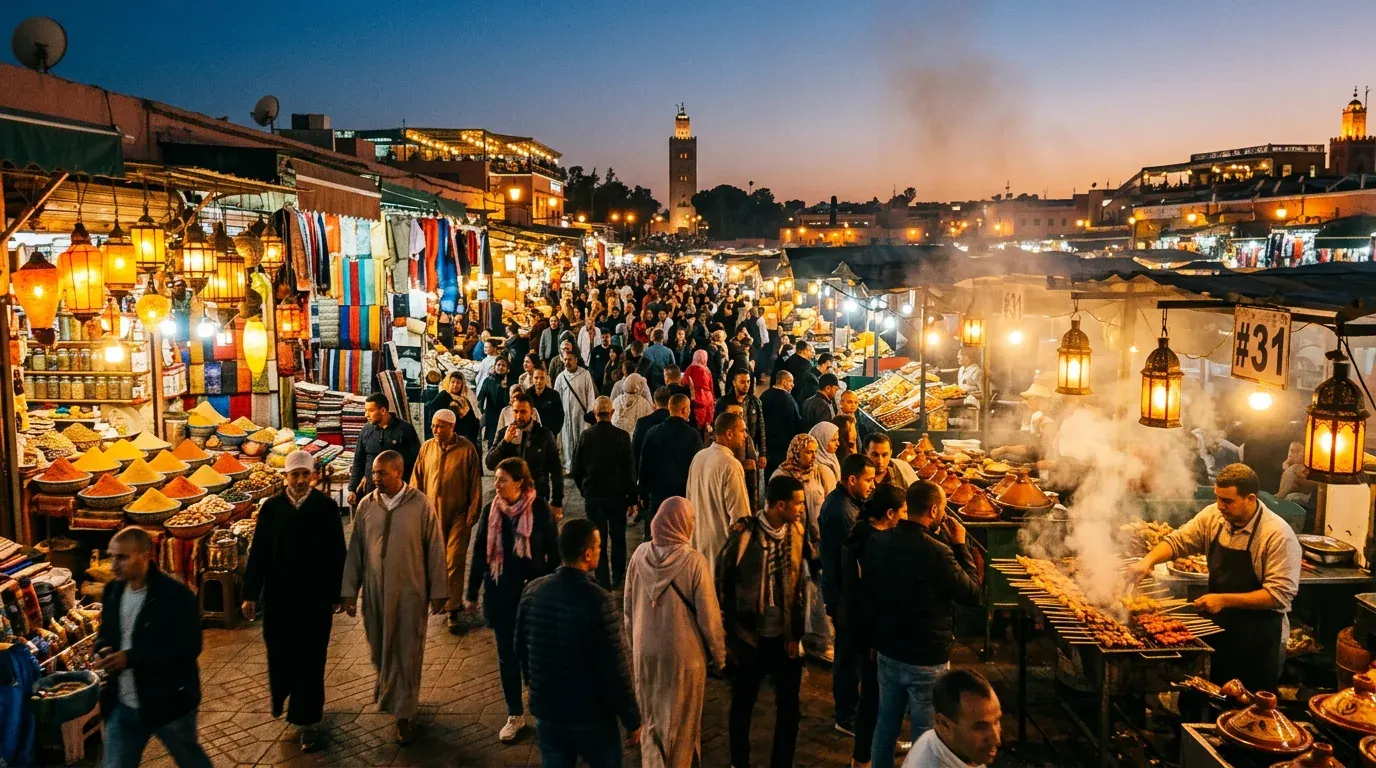
Marrakech runs at full volume, and the trick is to let go of the clock — at least for the first morning. Three days is enough to move through the medina at a human pace, take in the garden quarter, slip into the mountains for a day, and leave feeling you tasted the place rather than just ticked it off. Coming from the hushed blue lanes of the north, the contrast is half the pleasure. Here is how we structure the three days for our guests.
Day One: The medina on foot
Start at Djemaa el-Fna before 9 am, while the square still belongs to the orange-juice carts and locals cutting across to work. Head north into the souks with a licensed guide for the first couple of hours — the tanneries near Bab Debbagh, the dyers' alley, the spice sellers ringing Rahba Kedima. As the morning warms, pause at a rooftop café looking down over the square.
After lunch, give the Ben Youssef Madrasa an unhurried hour — the city's finest piece of historic religious architecture, beautifully restored and well worth the ticket. Spend the late afternoon drifting through the Mouassine quarter with no map at all. For dinner, choose a neighbourhood restaurant over the spectacle places on the square; your riad host will know one that fits your pace.
Come back to Djemaa el-Fna once it is dark. The square becomes a vast open-air kitchen and theatre. Keep walking through it rather than settling at one stall — you read it better in motion.
Day Two: The garden quarter and palaces
Reserve Majorelle Garden for 8 am — slots sell out and the early light is kindest. Yves Saint Laurent and Pierre Bergé brought the garden back from ruin in 1980; the cobalt-blue Villa Bou Saf Saf at its centre and the Museum of Moroccan Arts inside are worth a good 90 minutes. The neighbouring Musée Yves Saint Laurent Marrakech (YSL Museum) is a striking building and rewards a visit if fashion history interests you — it sits in the same entry area. Allow two hours for the quarter overall.
In the afternoon, cross to the southern medina for the Saadian Tombs and El Badi Palace. The tombs take twenty minutes, but the carving in the Chamber of Twelve Columns is exceptional. El Badi is a roofless ruin, yet the scale of what was once the most lavish palace in the Islamic world is still legible in the foundations, with storks nesting along the walls. In the evening, head to Gueliz, the modern district, for a change of tempo and some of the city's better contemporary cooking.
Day Three: Atlas Mountains day excursion
Set off by 8 am in a private vehicle. Where you go depends on the group: Ourika Valley (60 km, paved road to 1,800 m, the waterfalls at Setti Fatma) makes a relaxed day with a riverside lunch. Imlil (90 km, around 1,740 m at its base) suits walkers — a three-hour loop above the village through high hamlets and walnut orchards delivers a real Berber-highland day without any technical climbing.
We point first-timers toward Ourika and send returning visitors to Imlil for something further afield. Either way you are back in Marrakech by late afternoon, with the option of a stop at the Agafay Desert on the Imlil road. Browse our Atlas day tours for the full range.
Where to stay
A medina riad — a courtyard house turned guesthouse — is the only kind of stay we suggest for a first Marrakech visit. Prices span a wide band: a well-run mid-range riad runs US$80–140 a night for a double, while boutique riads with a pool, live-in staff and considered design reach US$180–350. Anywhere inside Bab Doukkala, Mouassine or the Mellah keeps every sight within a 15-minute walk. We help all our guests with riad selection as part of our concierge service.
Pacing and what to skip
The classic error is cramming in too many monuments. Two or three sites a day, with loose time in the souks between them, beats five with no room to breathe. Drop the Bahia Palace if the clock is tight — it is handsome but seldom the memory people carry home. And wave off any “free” guide who offers to orient you in the medina; that unofficial trade runs on commissions from carpet and argan-oil shops.
A few practicalities: keep small dirham notes for the souks, book Majorelle and the YSL Museum online ahead of time, and steer clear of the main-square restaurants at dinner — the menus are built for tourists and rarely live up to the setting. Marrakech's best food is in neighbourhood places where the menu is short and shifts with the day.
Frequently asked
Is three days in Marrakech enough?
Three full days covers the essentials at a civilised pace — the souks, Djemaa el-Fna after dark, the garden quarter and one day in the Atlas. What you sacrifice is depth, and Marrakech is a city that keeps revealing more, which is why many guests stretch it to five or pair it with the calmer blue north for contrast.
What is the best area to stay in Marrakech?
For a first stay, a riad inside the medina walls keeps everything within walking reach. The Mouassine quarter in the northern medina, or the Bab Doukkala neighbourhood, balances atmosphere, relative calm and quick access to the souks. If you would rather have a pool and a modern hotel, the Hivernage and Gueliz districts suit you better.
When is the best time to visit Marrakech?
Mid-February to April and October to early December give mild days of 20–26 °C, workable crowds and dependable sun. July and August routinely climb above 38 °C and make walking the medina genuinely hard going. December and January turn cool and sometimes wet, though the holiday mood in the old city has its own charm.
Do I need a guide for the medina?
For your first morning in the souks, a licensed guide earns every dirham — the maze of derbs is genuinely disorienting, and a good one steers you to craft quarters and hidden fondouks you would never stumble on alone. By day two you will have the main arteries in your head and can wander freely. We can arrange a medina guide for your first morning.
How do I get from Marrakech Menara Airport to my riad?
Official grands taxis and the Airport Express (bus line 19) are the budget routes. For Chefchaouen Blue City Tours guests we arrange a private chauffeured transfer — the car meets you at arrivals, takes the luggage and drops you as close to the riad door as the narrow medina streets allow.
Can I do an Atlas day trip from Marrakech?
Yes. The Ourika Valley sits about 60 km out and makes an easy four-to-five-hour outing. The Imlil trailhead for Toubkal is a 90-minute drive and suits walkers. Aït Ben Haddou and Ouarzazate are a full-day round trip of roughly 350 km — ambitious but rewarding. We set the pace to match your group rather than a fixed schedule.
Ready to go deeper?
We build itineraries around the Marrakech most visitors never find — and the quiet north beyond it.
Every Chefchaouen Blue City Tours guest travels with a private driver, a medina guide and WhatsApp support during the trip. No group buses, no commission shops, no script — and we can carry the trip on to the blue city whenever you want the calm.
Request an itinerary