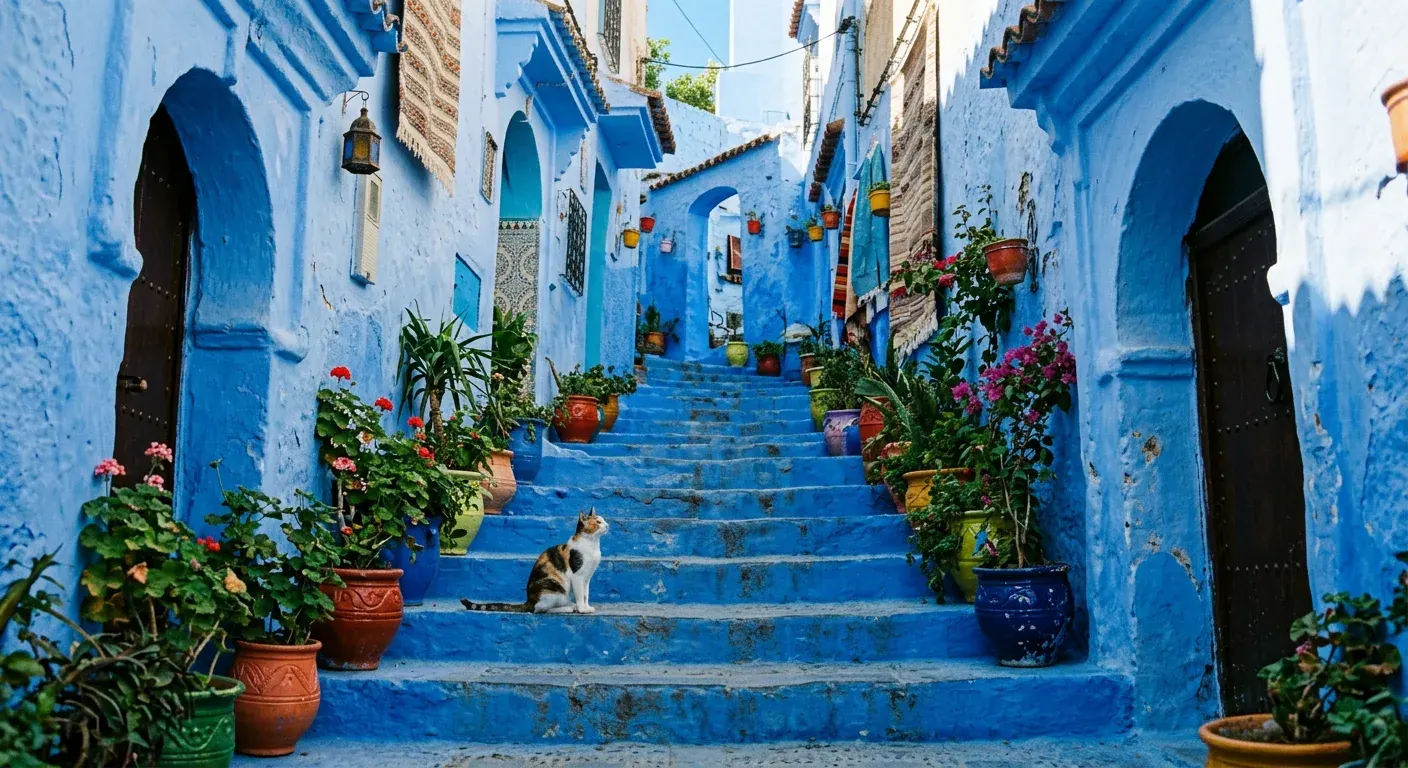
Here is the honest answer up front: Chefchaouen is a small mountain town, not a sprawling imperial city, and you do not need long to see it. The famous blue medina is compact and walkable — most people can cover the main blue lanes in a few hours. So the real question is not how much there is to see, but how much time the place deserves once you factor in the long drive to reach it and the quiet, golden hours that make it special. For the great majority of travellers the answer lands between one and two days. Here is how to decide where you fall.
The short answer
One night and two days is the sweet spot for most visitors. A half-day or day trip covers the headline sights if you are short on time, one night unlocks the sunset and the quiet early-morning lanes that day-trippers never see, and two to three days only earns its keep if you want to hike the Akchour waterfalls or simply slow right down in the Rif. Be wary of over-planning Chefchaouen: it is genuinely small, and the time you free up by keeping it to a night or two is usually better spent elsewhere in Morocco.
Half-day or day trip — the essentials
Because the medina is so compact, you really can take in the essentials in a few hours. A focused visit covers the photogenic blue lanes, the central Plaza Uta el-Hammam with its red-walled kasbah, a climb up to one of the higher viewpoints, and the Ras el-Maa stream and washing-place at the medina's eastern edge where the water tumbles down from the mountains. Many people see Chefchaouen exactly this way — as a long day trip, most commonly from Fes (roughly 4 hours each way) or from the closer northern bases of Tangier and Tetouan.
The honest trade-off is timing. A day trip drops you into the medina in the middle of the day, when the lanes are at their busiest with other coaches and the overhead light is flat and harsh on the blue walls — and you are usually back on the road before the town empties out and the light turns golden. You will see Chefchaouen, but you will see it at its least magical. Choose this option if your schedule genuinely forces it, ideally from a nearby base where the drive does not swallow the whole day.
One night, two days — the sweet spot
For most travellers this is the right amount of time, and it is what we recommend if you can spare it. An overnight gives you the two things a day trip simply cannot reach: a sunset and a quiet morning. Arrive in the afternoon, settle in, then climb to the Spanish Mosque on the hill above the medina for the classic sunset view — golden light spilling across the whole blue town with the Rif mountains behind. Wander the lanes unhurried as the day-trippers leave, enjoy a relaxed dinner, and you are perfectly placed for the best moment of all: the empty blue alleys at first light, before the next day's coaches arrive.
Two days is enough to do all of this without rushing — slow mornings, unhurried photography in soft light, mint tea on a terrace, the kasbah and ethnographic museum, and the wool and weaving souks. It is the version of Chefchaouen people fall in love with, and it asks for very little extra effort over a day trip. If you take only one piece of advice from this guide, it is this: stay the night.
Two to three days — for hikers and slow travellers
A third day in Chefchaouen is worth it for a specific reason rather than for the town itself, which you will have seen comfortably in two. The strongest case is hiking. The Akchour waterfalls and the dramatic God's Bridge rock arch in Talassemtane National Park make a rewarding half-to-full-day excursion into the Rif, and they are the main reason to extend your stay. Beyond that, a third day suits slow travellers who simply want to linger, photographers chasing more light, or anyone keen to day-trip the surrounding mountain villages and Rif nature.
Be honest with yourself here: if you are not going to hike or actively relax, you will likely run out of new things to do in the town after two days. Chefchaouen rewards depth and slowness, not a long sightseeing checklist — so add days only if you will use them for the Rif or for rest, and otherwise carry that time on to Fes, Tangier or the desert.
The drive shapes the decision
One practical factor underpins all of the above: Chefchaouen sits high in the Rif with no airport and no train, so every visit involves a road journey. As a rough guide it is around 2 hours from Tangier, a shorter hop from Tetouan, and roughly 4 hours from Fes via Ouazzane. The closer your base, the more a day trip makes sense. From Fes in particular, where you would spend around 8 hours in the car for a few hours in the medina, an overnight is far better value — do the drive one way and stay, rather than there and back in a day.
However long you settle on, we can fold Chefchaouen into a wider northern route at the right pace. Browse our private tours and destinations guide, or tell us your dates and we'll build the blue city into your trip with the right amount of time.
If you stay overnight, see things to do in Chefchaouen at night.
Frequently asked
Can you see Chefchaouen in a day?
Yes — the blue medina is compact and walkable, so a few unhurried hours are enough to cover the main blue lanes, Plaza Uta el-Hammam, the kasbah and the Ras el-Maa stream at the medina's edge. Many people visit Chefchaouen as a long day trip from Fes (around 4 hours each way) or from Tangier and Tetouan (closer). The catch is that a day trip lands you in town at the busiest, flattest-light part of the day and you leave before the place softens, so you see the sights but miss the atmosphere.
How many days do you really need in Chefchaouen?
For most travellers, one night and two days is the sweet spot. Chefchaouen is a small mountain town rather than a big city, so you do not need long to cover it — but an overnight lets you wander the blue lanes unhurried, catch the Spanish Mosque sunset, enjoy a relaxed dinner and have the medina almost to yourself in the early morning before the day-trippers arrive. One to two days suits most visitors; only add more if you specifically want to hike or simply slow right down.
Is one night in Chefchaouen enough?
For the town itself, yes. One night gives you the two things a day trip cannot — a sunset and a quiet early morning — which are exactly when Chefchaouen is at its most beautiful. You arrive in the afternoon, watch the sun set over the blue town from the Spanish Mosque, have an unhurried dinner, then enjoy the empty lanes at first light before moving on. Stretch to a second night only if you want to add the Akchour waterfalls or simply linger.
Is Chefchaouen worth more than 2 days?
Only if you want to hike or fully unwind. The blue medina itself does not need more than a day or two — it is genuinely small. A third day earns its place if you plan to hike the Akchour waterfalls or God's Bridge in Talassemtane National Park, explore more of the Rif, or take day trips to surrounding villages. If you are not doing those, two days is plenty and you are better off spending the extra time elsewhere in Morocco.
Should I do Chefchaouen as a day trip or stay overnight?
If you can spare the night, stay. A day trip is genuinely feasible — especially from a nearby base like Tangier or Tetouan — but it spends a lot of the day driving and drops you into the medina at its busiest. An overnight unlocks the sunset, the quiet morning lanes and a slower Rif pace for very little extra effort. From Fes, where the drive is around 4 hours each way, an overnight is the far better use of the long journey.
How long is the drive to Chefchaouen?
Chefchaouen sits high in the Rif mountains with no airport and no train, so every visit involves a road journey. As a rough guide it is around 2 hours from Tangier, a shorter hop from Tetouan, and roughly 4 hours from Fes via Ouazzane. Those drive times are a big part of the trip-length decision: the closer your base, the more a day trip makes sense, while the long Fes drive is far better repaid by staying the night.
Get the timing right
We'll fit Chefchaouen into your trip at the right pace.
A quick stop, an unhurried overnight or a few Rif days with the Akchour waterfalls — tell us how long you have and what you want to see, and we'll build the blue city into your Morocco itinerary.
Request an itinerary