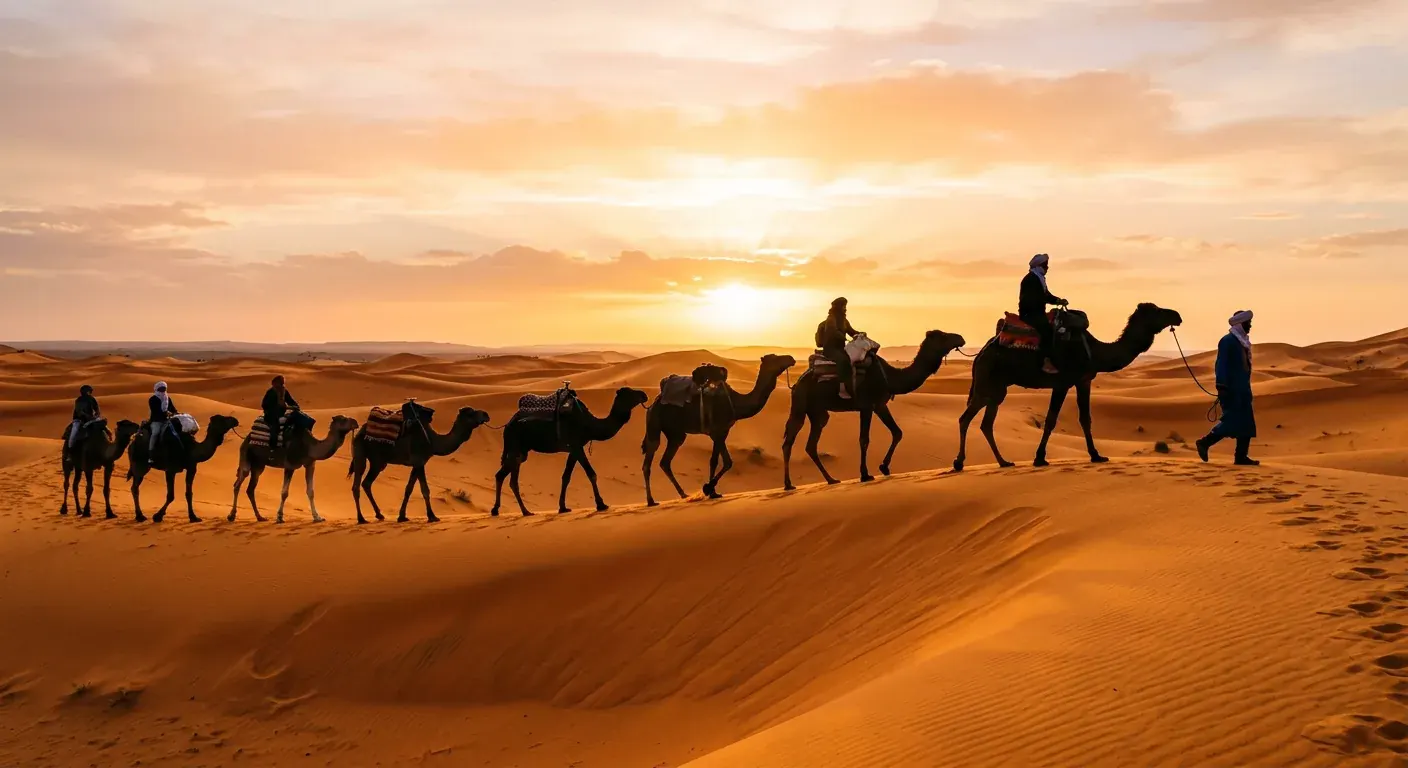
A night in the Moroccan Sahara is the kind of memory people retell for decades. The dunes catching the last light, the absolute hush after midnight, a sky so clean you can trace the Andromeda galaxy without a lens. It is also the opposite pole to everything Chefchaouen offers — where the blue medina folds you in close, the desert opens you up. But the phrase "desert camp" stretches from a shared tent on a rope cot to a freestanding pavilion with a king bed, an open-air shower and a private terrace. This guide lays out the differences plainly so nothing surprises you.
Erg Chebbi (Merzouga) vs Erg Chigaga (M'Hamid)
Two great ergs — seas of dune — carry the overnight camps in Morocco. Erg Chebbi, beside the village of Merzouga in the Tafilalet, is the one in every postcard: a tight wall of apricot dunes topping out near 150 m, with camps ringed along the sand a short camel or quad ride away. It is the easier of the two — tarmac to the threshold, regional flights into Errachidia, and the broadest sweep of operators from shoestring to lavish.
Erg Chigaga, some 50 km east of M'Hamid el-Ghizlane near Zagora, is the country's biggest erg and far more cut off. The final two hours mean 4×4 across piste, and most visitors tack on a camel or quad leg to reach the tents. What you get in return is near-perfect silence and a sliver of the crowds. We steer travellers who have already seen Erg Chebbi, or anyone chasing solitude above all, toward Chigaga. Browse our Sahara destination pages for more on both ergs.
Simple camps
The simpler camps — most of them at Erg Chebbi — pitch big canvas or Moroccan-style haima tents over plain iron or wooden bed frames, with basic cotton bedding and a shared block of toilets and cold showers for every four to eight tents. Dinner is a communal tagine or couscous in a central marquee. Reckon on US$40–80 per person, covering dinner, breakfast and a sunset camel ride.
The experience is honest and often unforgettable, but the variables run high — tent upkeep, kitchen quality and plumbing all swing widely between operators. Booking on your own, lean on reviews from the past three months. Booking through us, you get camps we have walked through ourselves.
Luxury and boutique camps
The luxury end has changed beyond recognition in the last decade. The strongest now set out freestanding private tents of 30–50 m² with real king beds rather than cots, en-suite or adjoining bathrooms with hot showers and flushing toilets, terrace seating and, here and there, a private plunge pool. The styling runs from pared-back Bedouin to a full riad mood carried out onto the sand.
Dinner at a good luxury camp is a true multi-course affair — harira soup, pastilla, slow-cooked mechoui lamb, Moroccan sweets — laid at a set table by candlelight rather than ladled from a buffet. A house musician usually plays once the plates are cleared. Expect US$200–600 or more per person, shifting with the camp, the season and the degree of seclusion. The most remote Erg Chigaga camps style themselves as all-inclusive lodges and price to match.
What a night actually covers
At any reputable camp, the usual inclusions are:
- Transfer from the village or road to the camp — camel, 4×4, quad or a mix, generally 20–60 minutes.
- Sunset on the dunes — most camps walk guests up a nearby crest for the hour before dark.
- Dinner — shared or private according to the camp tier.
- The tent itself — your room for the night, with quality that swings widely.
- Breakfast — bread, honey, olive oil, coffee, mint tea.
- Morning camel or 4×4 ride back to the road or village.
Often left out: alcohol (Morocco is a Muslim country — some camps will bring wine on request, others will not), sandboarding or quad bikes (usually billed separately), telescope stargazing (a real extra at several good camps), and laundry.
The road south and how to get there
From Chefchaouen: there is no quick way to the sand from the blue mountains. Plan two to three days — most travellers drop to Fes (around four hours) and then run on to Merzouga via Midelt and Errachidia, treating the descent as part of the trip rather than a slog to be endured.
Fès to Merzouga (Erg Chebbi): roughly 360 km by way of Midelt and Errachidia, 5–6 hours — doable in a single day with an early start. Many travellers string Chefchaouen, Fes and the Sahara together on one northern-to-southern arc.
Marrakech to M'Hamid (Erg Chigaga): about 530 km via Ouarzazate and Zagora, 7–8 hours to M'Hamid, then 2 hours of 4×4 piste to the erg itself. This is a committed journey and suits anyone giving the Sahara at least two nights. See our Sahara tours for multi-day routing.
When to go and what to pack
The best windows are October–November and February–April. December and January turn cold (lows near 5 °C or below) but hand you remarkable solitude. July and August are brutal — 40 °C-plus by afternoon, though the nights ease off.
Pack these whatever the month: a mid-weight fleece or down layer for the evenings (the same one you would want on a cool Rif night), a headtorch, sunscreen, lip balm for the bone-dry air, a shemagh or scarf against blowing sand, and a power bank, since charging is limited. Sand finds everything — seal camera gear in a zip bag.
Frequently asked
What sets Erg Chebbi apart from Erg Chigaga?
Erg Chebbi, outside Merzouga, is the easier and busier of the pair — tarmac runs almost to the sand, the main dunes sit a short camel ride away, and operators span everything from budget bivouacs to polished retreats. Erg Chigaga, beyond M'Hamid, lies a good two hours of rough piste from the last paved road, spreads across a wider area, and stays far emptier; you usually reach it by 4×4 or a longer camel or quad trek. Choose Chigaga when silence outranks convenience.
How long is the road from Chefchaouen down to the dunes?
There is no shortcut from the blue city to the sand — it is a southbound journey of two or three days. Most travellers drop from Chefchaouen to Fes first (about four hours), then push on through Midelt and Errachidia to Merzouga, or carry on to Marrakech and approach via Ouarzazate and the Tizi n'Tichka pass. We always build in an overnight rather than attempting the whole descent in a single sitting.
What does a night at a comfortable desert camp actually cover?
A properly run upscale camp gives you a private or semi-private tent with real beds and bedding rather than thin mats, an en-suite or dedicated toilet and shower, dinner served as several Moroccan courses (tagine, couscous or slow-roasted mechoui), breakfast, a sunset run by camel or 4×4 up to a dune ridge, and music around the fire afterwards. Some add telescope stargazing, a guided dawn walk on the sand, and quad bikes.
Does the Sahara really get cold after dark?
Far colder than newcomers expect, and the contrast catches even those used to the crisp Rif nights around Chefchaouen. In October and March the dunes can fall to 5–8 °C overnight; December through February sometimes brings frost. July and August stay mild after dark (20–25 °C) but the 40 °C-plus daytime heat makes summer hard going. Pack a fleece no matter the month.
When is the best season for the Moroccan Sahara?
October to November and February to April are the sweet spots — warm days around 22–30 °C, cool but bearable nights, and light on the dunes that is hard to describe. December and January turn cold yet reward you with the thinnest crowds and the rare chance of snow dusting a dune crest. Skip July and August unless punishing heat is the point of the trip.
Is a camel essential to reach the dunes?
Not at all. Most Erg Chebbi camps sit a 20–40 minute camel ride from the high dunes, but a 4×4 is quicker and kinder for anyone with mobility concerns. At Erg Chigaga the standard approach is a one- to two-hour camel trek, though vehicles get in too. Quad bikes are an option at both ergs for a more active arrival, and we match the transfer to each traveller.
Ready to sleep under the stars?
Every camp we put forward, we have checked ourselves.
Your Chefchaouen Blue City Tours run to the Sahara stays entirely private — your own vehicle, your own driver-guide, and a camp we have personally vetted. No shared groups, no compromises, all the way from the blue north to the open dunes.
Plan a Sahara journey