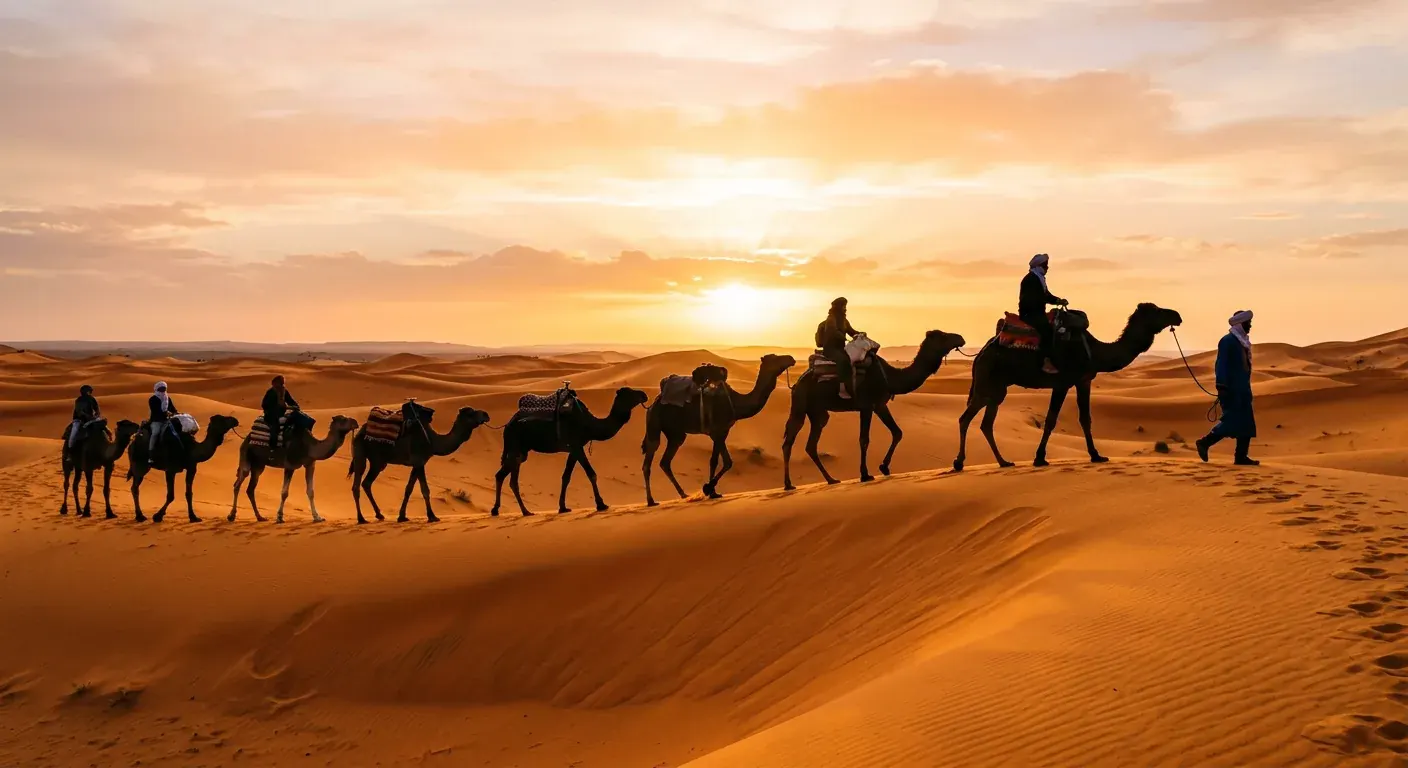
Seven days is the right measure for the north — long enough to let the blue city work on you, short enough to keep the driving gentle. The route below is one we have refined over many private journeys from the Rif: it weaves the coast at Tangier, the indigo medina of Chefchaouen, the green valleys behind it, and the deep history of Fès, without a single forced march. The southern desert is wonderful, but it belongs to its own week.
Day 1 — Arrive at Tangier and ease into the coast
Most flights land at Tangier in the afternoon. Rather than racing inland straight away, let the day breathe: a walk along the kasbah ramparts, the meeting of the Atlantic and the Mediterranean from Cap Spartel, and an early dinner of grilled fish. This first evening sets the unhurried tempo for the week. When you are ready, your driver collects you and the road begins to climb south toward the mountains.
Day 2 — Into the Rif: first light on the blue city
The drive from the coast to Chefchaouen takes around two and a half hours through olive terraces and mountain switchbacks, and the first sight of the indigo town folded into the hills never loses its effect. Check into a small riad inside the medina, then simply wander. The lanes wash from powder blue to deep cobalt as the afternoon turns; doorways, staircases and flowerpots are painted in a hundred shades. There is no agenda today beyond losing yourself in the colour and pausing for mint tea on a quiet square.
Day 3 — Chefchaouen: the Spanish Mosque, Ras el-Maa and the souks
Rise before the day-trippers and walk the twenty minutes up to the Spanish Mosque terrace; from there the whole medina lies below you, blue rooftops catching the first warm light over the valley. Back down, follow the water to Ras el-Maa, the cascade at the medina's edge where local women still rinse cloth and children paddle in the cool stream. The afternoon is for the souk around Place Outa el-Hammam, the kasbah garden, and the slow art of doing very little in a town that rewards it.
Day 4 — Akchour: waterfalls and the God's Bridge trail
A short drive east into Talassemtane National Park brings you to Akchour, the green heart of the Rif. Two walks share the trailhead: the gentler riverside path to the lower waterfall, and the longer climb to the natural rock arch known as the God's Bridge. Both follow clear pools and pine-shaded gorges that feel a world away from the desert Morocco most visitors picture. Pack a swim and a picnic, take it at the pace of the stream, and return to the blue city for a final evening on a rooftop.
Day 5 — Over the Rif to Fès
Leave Chefchaouen mid-morning for the four-hour drive south to Fès, the road unspooling through cork-oak hills and farming country. It is a travel day, but a scenic one, with easy stops for coffee and a roadside view. Arrive in time to settle into a riad inside Fès el-Bali — the largest car-free urban area in the world — and take an early-evening orientation walk before dinner in a Fassi restaurant. The shift in register, from the quiet blue lanes to the dense medieval city, is part of the journey's pleasure.
Day 6 — Fès el-Bali: tanneries, medersa and the artisan lanes
Give Fès a full, guided day. The Bou Inania Medersa is among the finest examples of Moroccan stucco and zellige work anywhere in the country. The Chouara tanneries are best seen from the leather-shop terraces above — go before 11 am while the vats are active and the colours are deepest. Between the landmarks, let the craft quarters reveal themselves: coppersmiths, weavers, the woodwork museum at the Nejjarine fountain. Lunch in a neighbourhood restaurant, far from the tourist-facing squares.
Day 7 — A final Fès morning and farewell
Fès rewards an unhurried last morning. Cross the river to the Andalusian quarter, the quieter and almost untouristed half of the medina, where neighbourhood bakeries and communal ovens carry on as they have for centuries. A last mint tea, a slow circuit of the artisan lanes, then a transfer to Fès airport for your onward flight. Seven days, one calm corner of Morocco, a hundred shades of blue. If the desert calls, we will gladly add a southern week to the front or back of this route.
Frequently asked
Is seven days enough to see the north of Morocco?
Seven days is plenty for a deeply satisfying northern journey if you keep the rhythm calm: arrive at Tangier, settle into the blue lanes of Chefchaouen for two unhurried nights, then drop down to Fès. Adding the southern desert loop on top usually means rushed driving days and tired travellers, so we treat Marrakech and the Sahara as a separate trip or an optional extension.
What is the best time of year for this northern Morocco itinerary?
March to May and September to November sit in the sweet spot — soft light over the Rif, comfortable walking weather in the Chefchaouen medina, and clear mornings for the Spanish Mosque viewpoint. July and August are warm in Fès but the blue city stays a little cooler at altitude. Winter is quiet and atmospheric, though the high mountain tracks toward Akchour can be wet.
How do we arrive — there is no airport in Chefchaouen?
Correct, the blue city has no airport. Most guests fly into Tangier (about two and a half hours by road) or Fès (roughly four hours through the Rif), and we collect you at arrivals. The drive itself is part of the pleasure: olive terraces, mountain switchbacks and the first glimpse of the indigo town folded into the hills.
How much does a private 7-day northern Morocco tour cost?
Fully private, with a driver, comfortable riad and guesthouse stays, most meals and all road transfers, expect US$2,200–4,200 per person depending on group size and the standard of accommodation. Larger groups lower the per-person figure noticeably. We send an exact quote once we understand your dates and pace.
Can we follow this itinerary independently without a guide?
You can — the roads are paved, navigation apps work, and English is widely spoken in the riads. Even so, a private driver who knows the Rif handles the mountain bends, points you to the quiet corners of the medina away from the crowds, and can reroute around weather on the Akchour road. For a first visit to the north, most of our guests find it makes the week flow.
What should we pack for a week in the blue city and the north?
Light layers earn their place: Chefchaouen sits at altitude, so mornings on the Spanish Mosque trail are cool even in summer while afternoons in Fès are hot. Sure-footed walking shoes matter — the medina steps and the path to Ras el-Maa defeat suitcase wheels. A light scarf is useful at mosque thresholds and on breezy ridgelines. Bring a small daypack and leave the wheeled luggage in your riad.
Ready to plan?
We'll build this itinerary around you.
Every Chefchaouen Blue City Tours journey is private and made to measure — we adapt the pace, the riads and the detours through the Rif to suit your group, and we can fold in the southern desert if you want both worlds. Reach out and we'll send a tailored proposal within 24 hours.