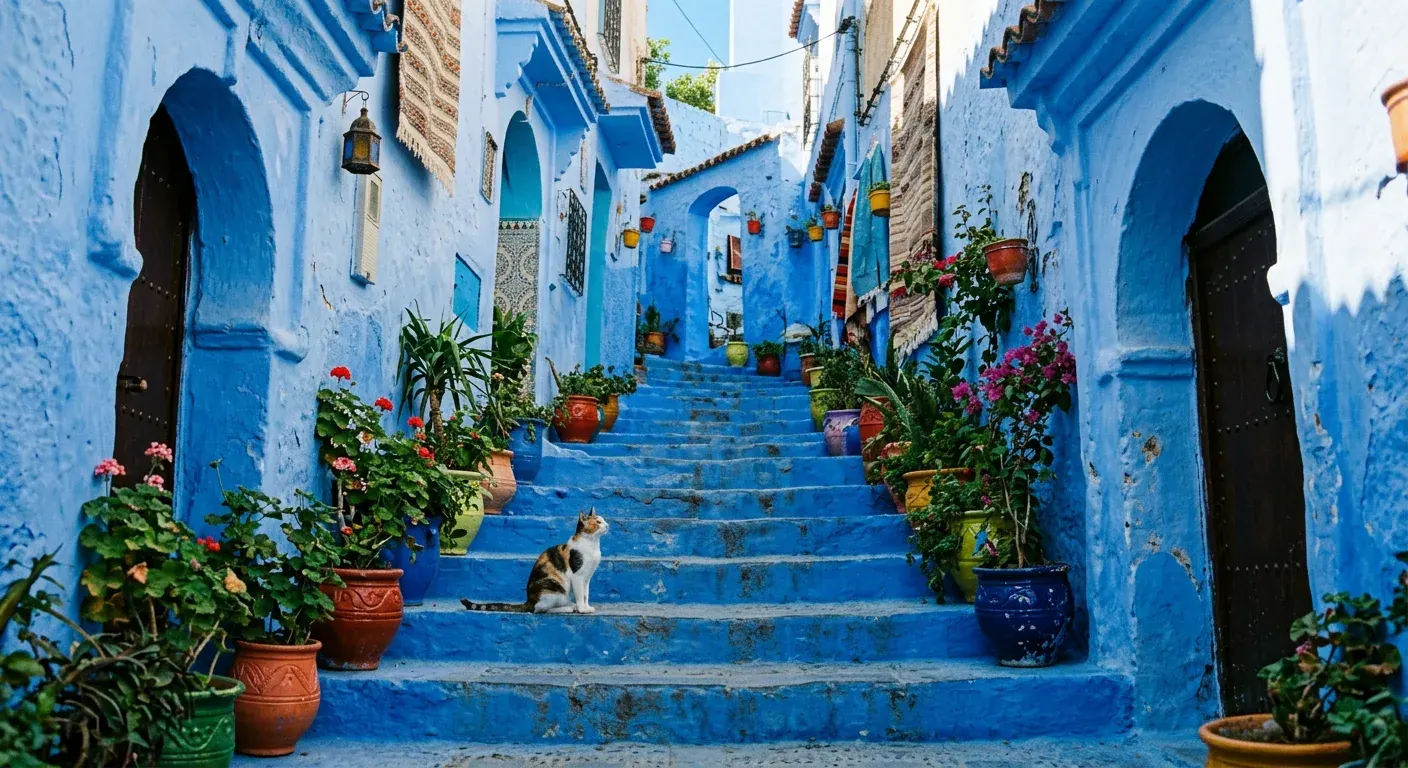
Chefchaouen is a small town. You can walk the whole medina in under an hour, so wherever you stay you're never far from anything. That makes the decision less about location in the big-city sense and more about the kind of stay you want — atmosphere inside the blue lanes, or ease of access from a car. Below we break the town into the handful of areas that actually matter, and we're honest about the catch with each. Most visitors stay one or two nights, so it's worth getting right.
Inside the medina — the blue lanes
This is where most people should stay, and where the experience lives. The medina is the blue city — small guesthouses, riads and dars (traditional courtyard houses) tucked into the lanes, many with rooftop terraces looking over the rooftops to the Rif Mountains. You're steps from Plaza Uta el-Hammam and the kasbah, and crucially you're still inside the medina at dusk and first light, when the day crowds have gone and the streets are at their best.
The honest catch is the terrain. The medina climbs a hillside on narrow, stepped cobbled lanes, and cars can't reach most guesthouses — you park outside the old town and walk in, carrying your bags the last stretch. It's charming and it's tiring in equal measure. If you travel light and don't mind steps, staying here is an easy yes. If you have heavy luggage or limited mobility, read on.
Around Plaza Uta el-Hammam — the central square
Plaza Uta el-Hammam is the heart of the medina — the broad café-lined square with the kasbah and the grand mosque on its doorstep. Staying on or near the square puts the town's social centre, its cafés and its main sights immediately outside your door, which is convenient if you want to drop your bags and step straight into the action.
The trade-off is the flip side of that convenience: the square is the liveliest part of town, busy with cafés and visitors through the day and into the evening, so it's less of a retreat than the quieter upper lanes. If you like being in the middle of things, that's a feature; if you want calm, aim higher up the hill.
The upper town — towards the Spanish mosque
Higher up the medina, towards the hill crowned by the Spanish mosque, the lanes grow quieter and the views open out. This is the side of town for the classic panorama over the blue rooftops — best at sunrise — and staying up here means you're closest to that walk and a step removed from the busiest streets.
The catch is simple: it's a climb. The reward of quiet and a view comes at the cost of more steps up and down every time you head into the square or out of town. For travellers who value calm and don't mind the legwork, it's the most rewarding corner to wake up in.
Just outside the medina — easier access and parking
Around the edges of the old town and on the avenues just below it, you'll find larger hotels with vehicle access and parking. This is the practical choice if you're self-driving, travelling with heavy bags, or anyone for whom the stepped lanes would be hard work — you can park at or near the door and avoid the long carry up into the medina.
What you give up is immersion. You're a short walk from the blue quarter rather than inside it, so you don't get the same waking-up-in-it feeling, and you'll walk in and out for the medina's evenings and early mornings. For many drivers that's a fair swap for the convenience — and the walk in is genuinely short.
So which area is right for you?
- Want the full experience and travel light — stay inside the medina, in the blue lanes.
- Want cafés and sights on your doorstep — stay on or near Plaza Uta el-Hammam.
- Want quiet and the rooftop view — head to the upper town towards the Spanish mosque, and accept the climb.
- Driving, or want parking and easy access — choose a hotel just outside the medina.
Whichever you pick, remember the town is small and the distances are short. The single biggest factor is steps versus parking — sort that out honestly for your own situation and the rest follows. See our destinations guide and private tours for trips that build Chefchaouen into a wider northern Morocco circuit.
Frequently asked
Where is the best area to stay in Chefchaouen?
For most visitors, inside the medina — the blue quarter. It puts you within a few minutes' walk of Plaza Uta el-Hammam, the kasbah and the lanes everyone comes to see, and it means you're still there at dusk and dawn when the day-trippers have gone. The trade-off is steps: the medina is built on a slope of narrow cobbled lanes, cars can't reach most guesthouses, and you'll be carrying your bags the last stretch. If that's a problem, a hotel just outside the old town with parking makes more sense.
Can you drive into the medina in Chefchaouen?
Largely no. The medina is a maze of narrow, stepped lanes closed to general traffic, so you park outside the old town and walk in. There are car parks and on-street parking around the edges of the medina — near Plaza Mohammed V and the avenues below the blue quarter. If you're self-driving, factor that walk in with luggage, or choose a hotel just outside the medina where you can park at the door.
How many nights should I stay in Chefchaouen?
Most visitors stay one or two nights, and that's about right. One night lets you see the blue streets at dusk and at first light, which is the real reward of staying over rather than day-tripping. Two nights gives you an unhurried day for the Spanish mosque viewpoint, the Ras el-Maa spring and a slower wander without watching the clock. Beyond two nights the town is small enough that you'll have covered the main sights.
Is it worth staying inside the medina despite the steps?
For most people, yes. Staying in the blue quarter is the experience — you wake up in it and you're there in the quiet hours either side of the day crowds. The honest caveat is mobility: steep cobbled lanes and stairs are tiring with heavy bags or for anyone with limited mobility, and you'll do that walk every time you come and go. If steps are a real concern, a hotel just outside the medina with vehicle access is the comfortable choice.
What kind of accommodation does Chefchaouen have?
Chefchaouen is a small mountain town, so it's mostly small-scale and family-run: guesthouses, riads and dars (traditional houses built around a courtyard) inside the medina, plus a handful of larger hotels around the edges and just outside the old town. Rooftop terraces are common and worth seeking out — the view over the blue rooftops to the Rif Mountains is the town's signature. We arrange the stay as part of a wider northern Morocco trip rather than recommending any one venue here.
Northern Morocco circuits
We'll match your stay to how you travel.
Inside the blue lanes or just outside with parking — we arrange the right base in Chefchaouen as part of a wider northern loop. Private car, curated guesthouses, early starts. Tell us what you're after.
Request an itinerary