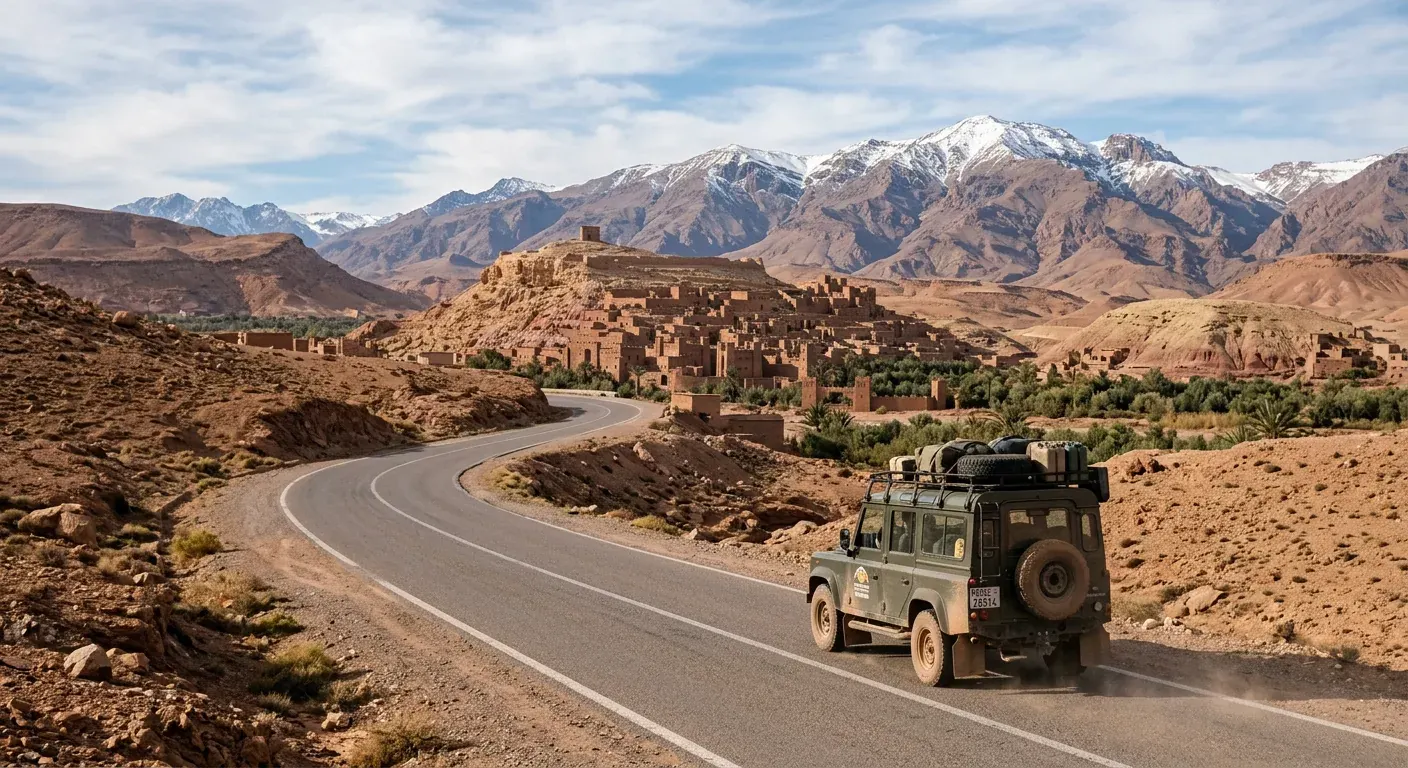
Reaching Chefchaouen is a road journey by definition — the blue city has no airport, so every arrival comes up through the Rif by car, bus or transfer. It is a beautiful drive, with the mountains folding higher and the air turning cooler as you climb, but the final ascent rewards full attention. Here is what we tell guests, honestly, when they ask whether to take the wheel themselves on the way up.
What are the roads to the Rif actually like?
The fast part is easy. The autoroutes out of Tangier and Fes are well-surfaced, tolled and clearly signed, and they carry you most of the way north. The character changes once you leave them. The N2 and N13 that climb toward Chefchaouen are paved national routes but narrow and serpentine — long sequences of switchbacks where two coaches passing leave only centimetres between mirrors. After heavy rain, rockfall and run-off can litter the carriageway, and the shoulders often drop away without barriers. There is no need for a 4x4 on the sealed road into town, but the Akchour and Talassemtane tracks beyond the city quickly turn rough, and those we never recommend in a standard rental.
How do checkpoints work on the way up?
Gendarme checkpoints (barrages) are routine on the northern routes, not an anomaly. An officer steps into the road with a baton; you slow and stop. Keep your passport, your home licence, and your rental contract in the glove box, ready to hand over. They may check your speed — radar is common on the open Rif sections — and occasionally breathalyse. Morocco enforces a zero-tolerance drink-driving law: the limit is 0.0 g/L. Be courteous, patient and clear. If a fine is issued it is paid in dirhams on the spot; ask for a receipt (un reçu, s'il vous plaît).
Can you drive inside the blue medina?
No — the old medina of Chefchaouen is a maze of stepped indigo lanes, far too steep and narrow for any car. You leave the vehicle in a supervised car park near Place Outa el Hammam or by Bab el Ain at the edge of the old town — gardiens charge a few dirhams a day — and walk in on foot. Many of the prettiest streets climb by staircase, so wheeled luggage is awkward; your guesthouse will usually meet you at the nearest gate and help carry bags up to the riad. Plan to arrive, park, and continue on foot.
What does car hire cost for the trip north?
A small manual (Dacia Sandero class) runs roughly US$25–40 per day from international agencies (Avis, Hertz, Europcar) at Tangier or Fes. Local agencies quote less, but their insurance and breakdown cover are often thin — read the small print before you sign. Full collision damage waiver (CDW) and theft protection are worth paying for on mountain roads. Petrol is around US$1.20 per litre (diesel a little less), and stations are plentiful on the main routes; top up before the final climb, as the smaller Rif roads have fewer.
Why do most of our guests choose a private driver?
We are hardly impartial — we arrange private driver-guides for a living. But the reasons guests give us, after self-driving once and then switching, are consistent: the Rif switchbacks were more nerve-wracking than expected, parking and walking in at every stop ate into the day, the language at a checkpoint felt awkward, and they spent the drive watching the road instead of the mountains. A private driver erases all of that. Over a short northern loop the cost gap is modest — a driver-guide runs roughly US$150–220 per day all-in, which across four people is under US$60 each per day. You gain a local who knows the viewpoints over the Rif, the timing to reach the Spanish Mosque for sunset, and which café terrace catches the best light over the blue rooftops. See our guide service for details.
Practical rules if you do self-drive
- Never tackle the Rif descent after dark — unlit mopeds and roadside livestock are serious hazards.
- Download offline maps (Maps.me or Google Maps offline) before you set off — signal drops out across the mountain passes.
- Keep a physical copy of your rental contract, insurance, and passport photo page in the car.
- Fill the tank before the final climb — stations thin out on the smaller roads around Chefchaouen and the Talassemtane park.
- Stick to the sealed road into town; the Akchour and forest tracks need a 4x4 and local knowledge.
- At a checkpoint: engine off, window down, hands visible on the wheel. Slow and calm.
Frequently asked
Is it safe to drive to Chefchaouen as a foreigner?
The roads up to the blue city are perfectly driveable, but the Rif approach asks for more focus than a European motorway. The last stretch winds through tight switchbacks, town traffic treats lane markings as suggestions, and the mountain shoulders rarely have barriers. Visitors who arrive without drama take the bends slowly and finish the climb in daylight.
What documents do I need to rent a car for the drive north?
For most nationalities your home driving licence is accepted on its own — no International Driving Permit is needed to reach Chefchaouen. Bring your passport, a credit card in your own name, and be at least 21 (sometimes 23 for larger vehicles). Keep the rental agreement and insurance certificate in the car for the journey up from Tangier or Fes.
Do police stop tourists on the road to the Rif?
Frequently, yes. A gendarme stepping into the road with a baton is a normal sight on the N2 and N13 linking Tangier, Tetouan, Fes and Chefchaouen. Slow down gently, lower the window, and have your passport and rental contract within reach. After a quick look you are usually waved on. Stay relaxed and speak clearly and slowly.
What are the speed limits on the way to Chefchaouen?
Through towns such as Tetouan and Ouazzane: 40–60 km/h. On the open Rif roads: 100 km/h. On the Tangier and Fes autoroutes before you turn off: 120 km/h. Fixed cameras and handheld radar are common, and fines are settled on the spot in dirhams. Signs follow the familiar European format.
Is it better to hire a driver than self-drive to Chefchaouen?
For most first-time visitors, yes. Chefchaouen has no airport, so everyone arrives by road, and a private driver-guide removes the friction at once — the Rif switchbacks, parking outside the blue medina, language at a checkpoint, and patchy signal in the mountains. Across a few days the extra cost is small against the calm it buys.
Can I drive to Chefchaouen at night?
We strongly advise against the mountain stretch after dark. Unlit mopeds, livestock on the verge, unmarked speed bumps and tiredness make the Rif descent the riskiest part of a northern trip. Aim to roll into Chefchaouen before sunset so you reach your guesthouse while the blue lanes are still bright.
Skip the switchbacks
Let us put a driver-guide on the road to the blue city.
The private driver-guides we work with are English-speaking and know every bend of the Rif approach from Tangier and Fes. We can pair a driver with a local guide in Chefchaouen itself for a deeper walk through the indigo medina and the hills around it.