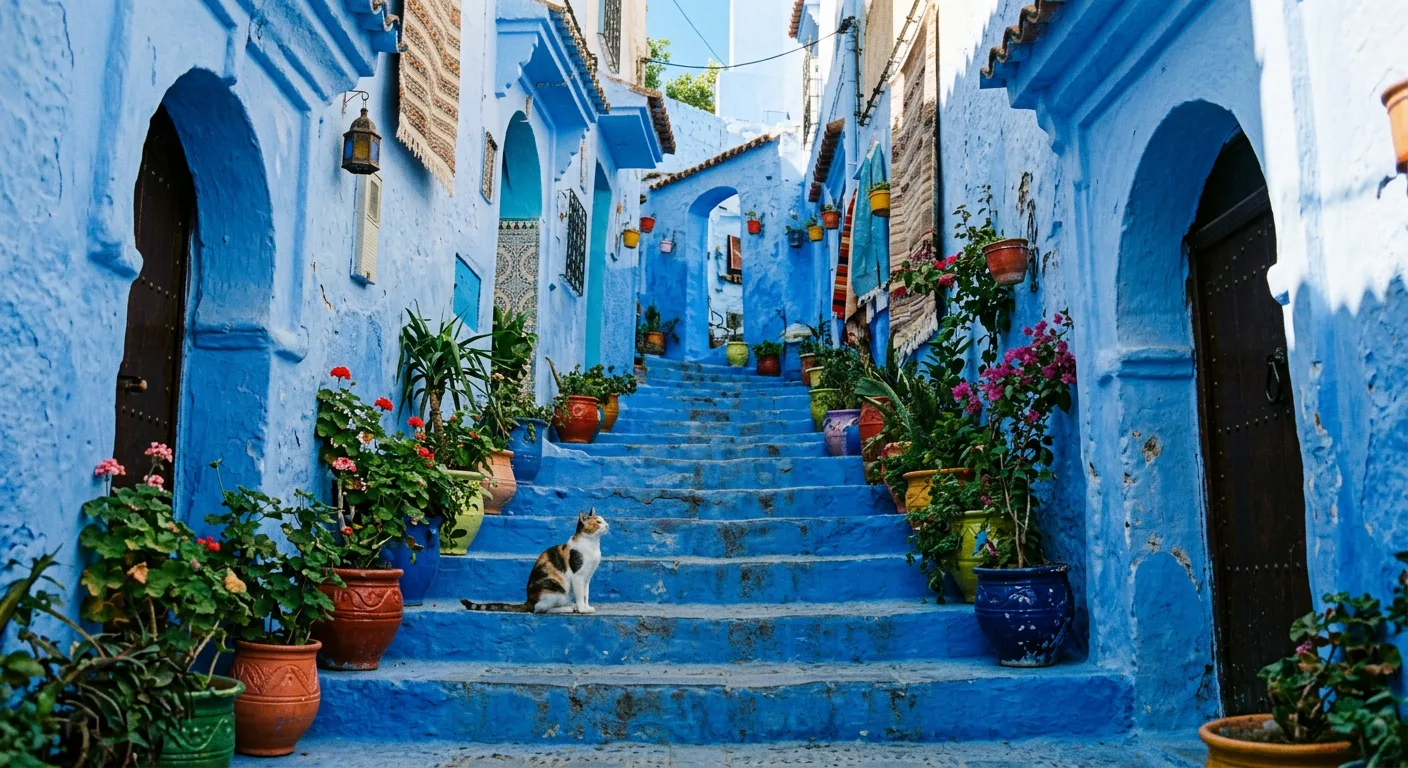
It is the question guests ask us most. The short answer: yes, Chefchaouen and the wider north are safe for the vast majority of travellers, and have been for many years. The longer answer — the one worth reading — turns on where you wander, how you travel, and which risks you are actually weighing. Here is what we tell our guests plainly, without the brochure shine.
What does the official travel advice actually say?
As of 2026, both the UK Foreign, Commonwealth & Development Office (FCDO) and the US State Department rate Morocco as exercise normal precautions for the main visitor areas — the same tier they give France, Spain and Portugal. Caution rises to exercise increased caution near the Algerian border and in remote Saharan strips far to the south-east, none of which touch the northern circuit. The popular north — Chefchaouen, Tangier, Tetouan, Fes and the Rif — sits firmly in the lowest advisory band.
Morocco's tourist police (police touristique) are uniformed and visible in the larger medinas, and the gendarmerie keeps a steady presence on the mountain roads. Chefchaouen itself is a small, close-knit town where strangers stand out and shopkeepers know their neighbours — part of why it feels calmer than the big-city souks. This is a country that leans on tourism and invests in protecting it.
Is it safe for women travelling alone?
Honestly, solo female travel in Chefchaouen is very doable and increasingly common — and the blue city is one of the easier places in Morocco to start. It still asks for a different alertness than, say, solo travel in Scandinavia. Verbal attention — a comment, a persistent shop invitation — happens, mostly around the busier squares, and more often than in northern Europe. It is almost always only words; physical crime against solo female visitors is genuinely rare here.
The measures that make a real difference: dress modestly in the medina (a light linen layer over bare shoulders costs nothing, and the cool Rif evenings make it welcome anyway); walk through the indigo lanes with intent rather than looking lost; choose a guesthouse where the staff know your name and your plans; take a licensed guide for your first walk through the old town or out to Akchour; and save your host's WhatsApp number in case anything feels off. With those basics, almost every solo woman we have hosted has had a wholly positive stay.
What scams should you know about?
The hustles around Chefchaouen are social and financial, never violent. The common ones:
- The helpful guide: someone offers to lead you to a 'secret' blue staircase or viewpoint, then asks for payment. Decline unsolicited offers; your guesthouse can arrange a licensed guide.
- The closed attraction: a stranger claims a spot or the path to the Spanish Mosque is shut and steers you elsewhere — often a relative's shop. Check with your accommodation first.
- The tea invitation: a shop owner invites you up for mint tea, then leans on you to buy once you are seated. Tea is a genuine gesture of Rif hospitality, but inside a shop it usually carries an expectation. Accept if you truly want to browse; leave firmly if not.
- Unofficial transport: unlicensed drivers touting transfers from the bus station. Use the official taxi rank or book your ride through your accommodation.
None of these involve force. They work because visitors feel awkward refusing or want to be polite. A calm, firm 'no thank you' in any language is always enough.
How safe is hiking the Rif around Chefchaouen?
The trails through Talassemtane National Park — out to the Akchour waterfalls, the Ras el-Maa stream and the high ridges above the blue city — are among the most welcoming outings in northern Morocco, and crime is barely a consideration on them. The real risks are environmental: water levels at Akchour rise fast after rain, the rock can be slick, and the longer routes to God's Bridge or the ridgelines are easy to misjudge. Take a licensed local guide for the bigger walks, carry plenty of water, and set off early so you are back before the light fades.
The 2023 earthquake was centred far to the south, near Al Haouz in the High Atlas, and did not affect Chefchaouen or the Rif. The northern trails are open and unaffected. As always, confirm current conditions and water levels with your guide before heading out.
What health precautions are worth taking?
Routine vaccinations — tetanus, hepatitis A — are recommended before any visit. Hepatitis B and typhoid are worth raising with your GP for longer rural stays. Tap water outside the better hotels is not reliably safe; drink sealed bottled water and skip ice in casual cafés. Remember that Chefchaouen sits at around 600m, so even warm days give way to cool evenings — a light layer keeps you comfortable on the terraces after dark.
Sit-down meals in Chefchaouen are generally very safe, and freshly cooked street food is fine when it is visibly hot. A mild stomach upset in the first days is usually just unfamiliar spices and oil rather than infection. Pack oral rehydration sachets, an antihistamine, and ask your GP for a broad-spectrum antibiotic to carry as a precaution. Travel insurance with medical evacuation cover is essential, since the best-equipped private hospitals are down in Tangier, Fes and Casablanca rather than in the mountains.
Our honest bottom line
Chefchaouen is a gentle, photogenic introduction to Morocco that rewards a little curiosity and basic street sense. The risks are real but proportionate — on a par with any small tourist town, and lower than many. We have run private trips through the north for years, and most of our guests finish their stay already planning the next one. If you would like a journey shaped for comfort and ease — from the road transfer up through the Rif to vetted accommodation and on-call support — we are here to help.
For more, browse our Chefchaouen travel guides and destination overviews.
Frequently asked
Is Chefchaouen safe for solo female travellers in 2026?
Yes, with the usual awareness. The blue city is one of the gentler places in Morocco to arrive alone — it is small, walkable, and the medina feels calmer than the big-city souks. The occasional verbal attention happens, mostly around the busier squares, but physical crime against visitors is rare. Dressing modestly (shoulders and knees covered), walking with purpose through the indigo lanes, and a firm 'la shukran' (no thank you) settle most of it. A guesthouse with staff who know your plans removes nearly all the friction.
What are the most common scams targeting visitors in Chefchaouen?
They are mild and social, not violent. Someone may offer to lead you to a 'secret' blue staircase or rooftop view and then ask for money; a shop may invite you up for tea and lean on you to buy; an unofficial 'guide' may attach himself near Bab el Ain. None involve force. The antidote is simple: know roughly where you are heading, say a guesthouse host is expecting you, and do not follow anyone who approaches you first in the medina.
Is it safe to hike the Rif around Chefchaouen — Akchour and the waterfalls?
Yes. The Talassemtane trails, the Akchour waterfalls and the Ras el-Maa stream are popular, well-walked and welcoming. For the longer routes — the God's Bridge arch or the high ridge — take a licensed local guide, not for any crime concern but for route-finding and water levels, which rise fast after rain. Stick to the marked paths, carry water, and start early so you are back before dusk.
What health precautions should I take before visiting Chefchaouen?
Routine vaccinations (tetanus, hepatitis A) are recommended; hepatitis B and typhoid are worth raising with your GP for longer rural stays. Tap water is best avoided outside the better hotels — drink sealed bottled water and skip ice in casual cafés. Sit-down meals are generally safe, and freshly cooked street food carries low risk. Chefchaouen sits at around 600m in the Rif, so evenings turn cool; pack a layer and carry oral rehydration salts, an antihistamine, and a broad-spectrum antibiotic from your GP just in case.
Has the safety situation in northern Morocco changed for 2026?
Northern Morocco and Chefchaouen remain stable and firmly on the visitor map. The country invests in tourist police, medina CCTV and a licensed-guide system, and the Rif sees steady, well-managed tourism. The 2023 earthquake was centred far to the south near the High Atlas and did not affect the north. Standard FCDO and US State Department advice rates Morocco as 'exercise normal precautions', the same tier as many popular European destinations.
Should I buy travel insurance for a Chefchaouen trip?
Yes — always. Choose a policy that covers medical evacuation, since the best-equipped private hospitals are down in Tangier, Fes and Casablanca rather than in the Rif. Any mountain rescue or transfer is far cheaper with cover than without. Most mid-range policies at US$40–80 for a two-week trip are adequate; just declare any pre-existing conditions.
Travelling with peace of mind
We've got your back from the road up to the blue lanes.
Every Chefchaouen Blue City Tours trip includes 24/7 WhatsApp support, vetted licensed guides, pre-screened guesthouses and pre-arranged transfers up through the Rif — so you can lose yourself in the indigo medina, not the logistics.
Request an itinerary