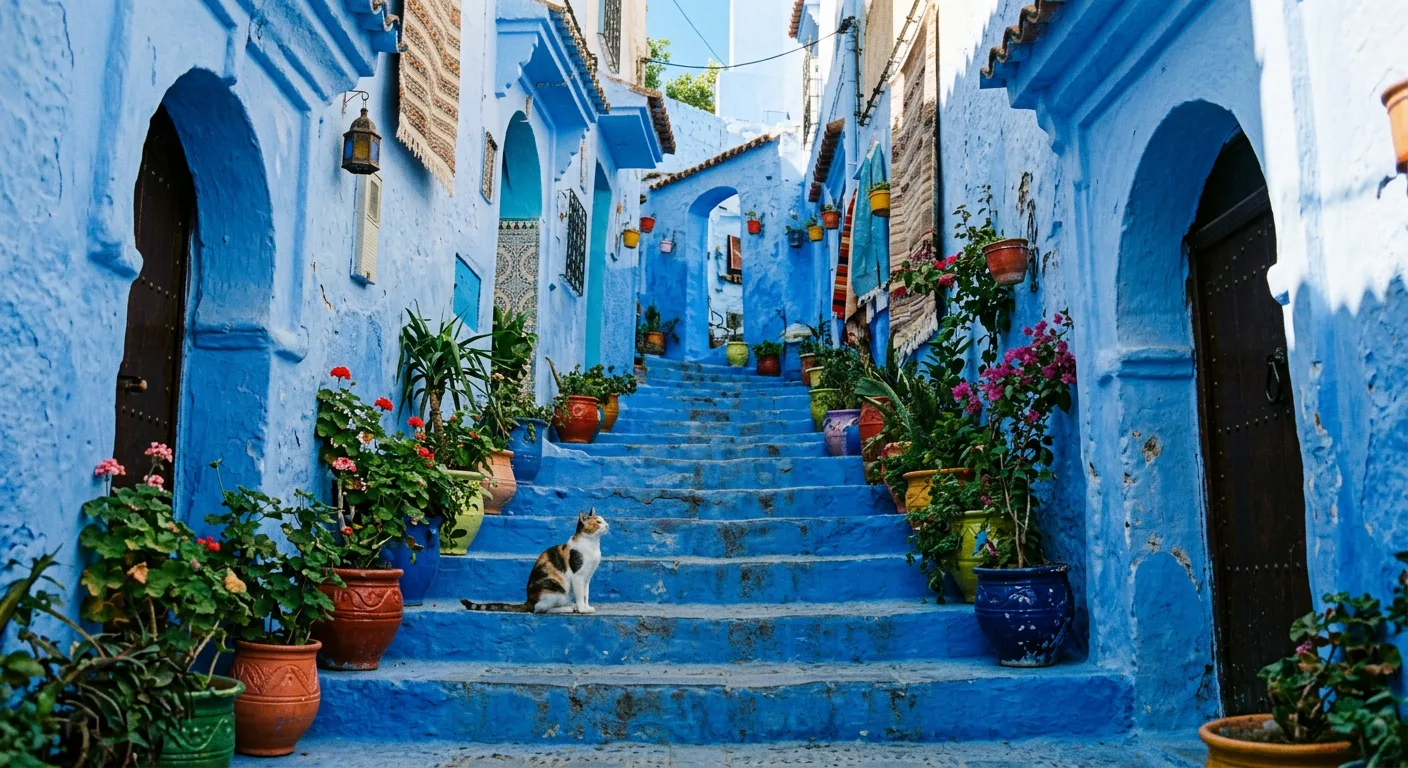
Here is the short version up front: Chefchaouen is worth visiting for most travellers, you get there entirely by road — roughly 2 to 2.5 hours from Tangier, about an hour from Tetouan and around 4 hours from Fes — and there is more around it than the famous blue lanes: the Akchour waterfalls in Talassemtane National Park, the wider Rif mountains, the UNESCO-listed medina of Tetouan and a stretch of Mediterranean coast. The town earns an overnight; the surrounding area can easily fill a second or third day. Below is the full, honest planning answer to every part of that question.
Is Chefchaouen actually worth it?
Yes — for a specific kind of trip. The obvious draw is the colour: the medina is washed in dozens of shades of blue, from pale powder to deep indigo, and tumbling down a Rif hillside it makes for some of the most atmospheric streets in Morocco. But the real pull is the pace. Chefchaouen is small, walkable and unhurried — mint tea on terraces, the gentle hum of Plaza Uta el-Hammam, the red-walled kasbah, and the Ras el-Maa stream where water tumbles off the mountains at the medina's edge. After the intensity of Fes or Marrakech, it feels like exhaling.
It is the wrong call if you have only three or four days based around Marrakech, if you want nightlife, beaches and big monuments, or if long winding mountain drives leave you carsick. We go deeper into the for-and-against in is Chefchaouen worth visiting, but the one-line test is this: if you want a calm, beautiful mountain escape and you are willing to either base nearby or build it into a wider northern route, it earns the detour.
How do you get to Chefchaouen?
The first thing to know is what Chefchaouen does not have: no airport and no train station. Every visit is a road trip, and the right starting point changes the whole plan:
- From Tangier (about 2–2.5 hours): the easiest and most common gateway. Tangier has the nearest big airport and a fast train link to the rest of Morocco, so most people fly or train into Tangier and drive the last leg.
- From Tetouan (about 1 hour): the shortest hop, and a natural pairing — Tetouan's UNESCO medina makes a good first or last stop.
- From Fes (about 4 hours via Ouazzane): very doable one-way if you stay overnight in Chefchaouen rather than rushing back.
- From Marrakech (about 8–9 hours): only as part of a longer northern loop, never a there-and-back trip.
For the last leg you have three choices: a CTM or Supratours bus (comfortable, fixed schedule, book ahead), a shared grand taxi (cheaper, leaves when full), or a private transfer or driver (door to door and the most flexible if you want to stop at Akchour or Tetouan on the way). The full version, including how to move around the steep, car-free medina once you arrive, is in our guide on getting to and around Chefchaouen.
What's around Chefchaouen — Akchour, the Rif and Tetouan
This is where Chefchaouen quietly outperforms its reputation as a one-photo town. Once you are based in the blue city, the surrounding Rif opens up.
The Akchour waterfalls and God's Bridge
The headline excursion is the Akchour waterfalls, about a 45-minute drive northeast into Talassemtane National Park. From the trailhead it is a riverside walk to the lower cascades and pools (roughly an hour each way) or a longer, steeper push to the higher falls; a separate path leads to God's Bridge, a natural rock arch over the river. Wear proper shoes, carry water, and go early in summer — it is the best half-to-full day of nature near Chefchaouen.
The Rif and Talassemtane National Park
Beyond Akchour, the wider Rif mountains are green, forested and far less travelled than the Atlas. Talassemtane protects rare Moroccan fir and a tangle of hiking trails; even a short walk uphill from town — to the Spanish Mosque viewpoint for sunset over the whole blue city — gives you the feel of the range. This is the gentler, cooler, leafier side of Moroccan mountains.
Tetouan and the Mediterranean coast
About an hour away, Tetouan has a UNESCO-listed medina with strong Andalusian roots — whitewashed, working and far less touristed than Fes. Push a little further and you reach the Mediterranean coast around Martil and Oued Laou for a beach afternoon. Either makes a natural day trip, or a stop on the way in or out. For the ranked list of excursions and honest drive times, see the best day trips from Chefchaouen.
What is there to do in the blue city itself?
Inside the walls, the medina is the attraction — wander rather than tick off sights. The set pieces are Plaza Uta el-Hammam and its restored kasbah and small museum; the Ras el-Maa stream where local women still rinse wool; the climb to the Spanish Mosque for the best view in town; and the wool, weaving and craft souks. Go early or near sunset, wander the upper and edge neighbourhoods, and the busy midday lanes give way to a real, lived-in Rif town.
How many days do you need?
For the town alone, one night and two days is the sweet spot — enough for the Spanish Mosque sunset and the empty blue lanes at first light, the two moments that justify the journey. Add a second night to hike Akchour properly, and a third if you also want Tetouan or the coast. A pure day trip works only from a nearby base like Tangier or Tetouan, and it drops you into the medina at its busiest. Our honest trip-length guide walks through each option.
When should you go?
Spring (April to early June) and autumn (mid-September to October) are the most reliable — comfortable mountain temperatures, green hillsides and good weather for Akchour. Summer is hot in the lowlands but cooler up in the Rif and busy in the medina; winter is quiet, misty and atmospheric but cold, and the Akchour trail can be muddy or swollen after rain. For the month-by-month detail, see the best time to visit Chefchaouen.
Putting it together
The easiest way to make the journey pay off is to fold Chefchaouen into a wider northern route rather than treating it as a standalone errand — fly or train into Tangier, drive in via Tetouan, give the blue city an overnight, take a day for Akchour and the Rif, and continue on to Fes or the coast. Browse our private tours, or tell us your dates on the contact page and we'll build Chefchaouen and the Rif into your trip at the right pace.
Frequently asked
Is Chefchaouen worth visiting?
Yes, for most travellers Chefchaouen is worth visiting — provided you plan the journey rather than fight it. It is a genuinely beautiful blue-washed town tumbling down a Rif mountainside, calmer and slower than Fes or Marrakech, and it photographs as well in person as online. The single caveat is access: there is no airport and no train, so every visit is a road trip. Get the route and trip length right and very few people regret going; rush it as a midday photo stop and you miss the point.
How do you get to Chefchaouen from Tangier or Fes?
By road only — there is no airport or railway station in Chefchaouen. From Tangier it is roughly a 2 to 2.5 hour drive, the easiest gateway and the one most visitors use. From Fes it is around 4 hours via Ouazzane. From Tetouan it is the shortest hop, about an hour. Your options are a CTM or Supratours intercity bus (book ahead, comfortable, fixed schedule), a shared grand taxi (cheaper, leaves when full), or a private transfer or driver (most flexible, door to door). For the full breakdown see our getting-to-and-around guide.
What is there to do around Chefchaouen?
The headline excursion is the Akchour waterfalls and God's Bridge in Talassemtane National Park — a half to full day of Rif hiking northeast of town. In Chefchaouen itself you have the blue medina, Plaza Uta el-Hammam and its kasbah, the Ras el-Maa stream, and the Spanish Mosque viewpoint for sunset over the whole blue city. Further out, Tetouan's UNESCO-listed medina is about an hour away, and the Mediterranean coast around Martil and Oued Laou is within reach for a beach day.
How many days do you need in Chefchaouen and the surrounding area?
One night and two days is the sweet spot for the town alone — it unlocks the Spanish Mosque sunset and the empty blue lanes at first light, the two moments that justify the trip. Add a second night if you want to hike the Akchour waterfalls properly, and a third if you also want Tetouan or the coast. A pure day trip works only from a nearby base like Tangier or Tetouan, and it lands you in the medina at its busiest.
Is Chefchaouen worth the long drive from Fes or Marrakech?
From Fes (about 4 hours each way), yes — if you stay overnight rather than racing there and back. From Marrakech it is a different answer: Chefchaouen is roughly 8 to 9 hours away, so it only makes sense as part of a longer northern loop via Fes, Tangier or the coast, never as a there-and-back excursion from a Marrakech base. The drive is repaid by a sunset and a quiet morning, not by a few crowded midday hours.
When is the best time to visit Chefchaouen and the Rif?
Spring (April to early June) and autumn (mid-September to October) are the most reliable — comfortable mountain temperatures, greener hillsides and good hiking weather for Akchour. Summer is busy and hot in the lowlands but cooler up in the Rif; winter is quiet, misty and atmospheric but cold, with the Akchour trail sometimes muddy or swollen after rain. For light on the blue walls, early morning and late afternoon win in any season.
Plan it properly
We'll build the blue city and the Rif into your route.
An overnight from Fes, a northern loop via Tangier and Tetouan, or a few Rif days with the Akchour waterfalls — tell us where you're starting and how long you have, and we'll make sure Chefchaouen earns its place in your Morocco itinerary.
Request an itinerary