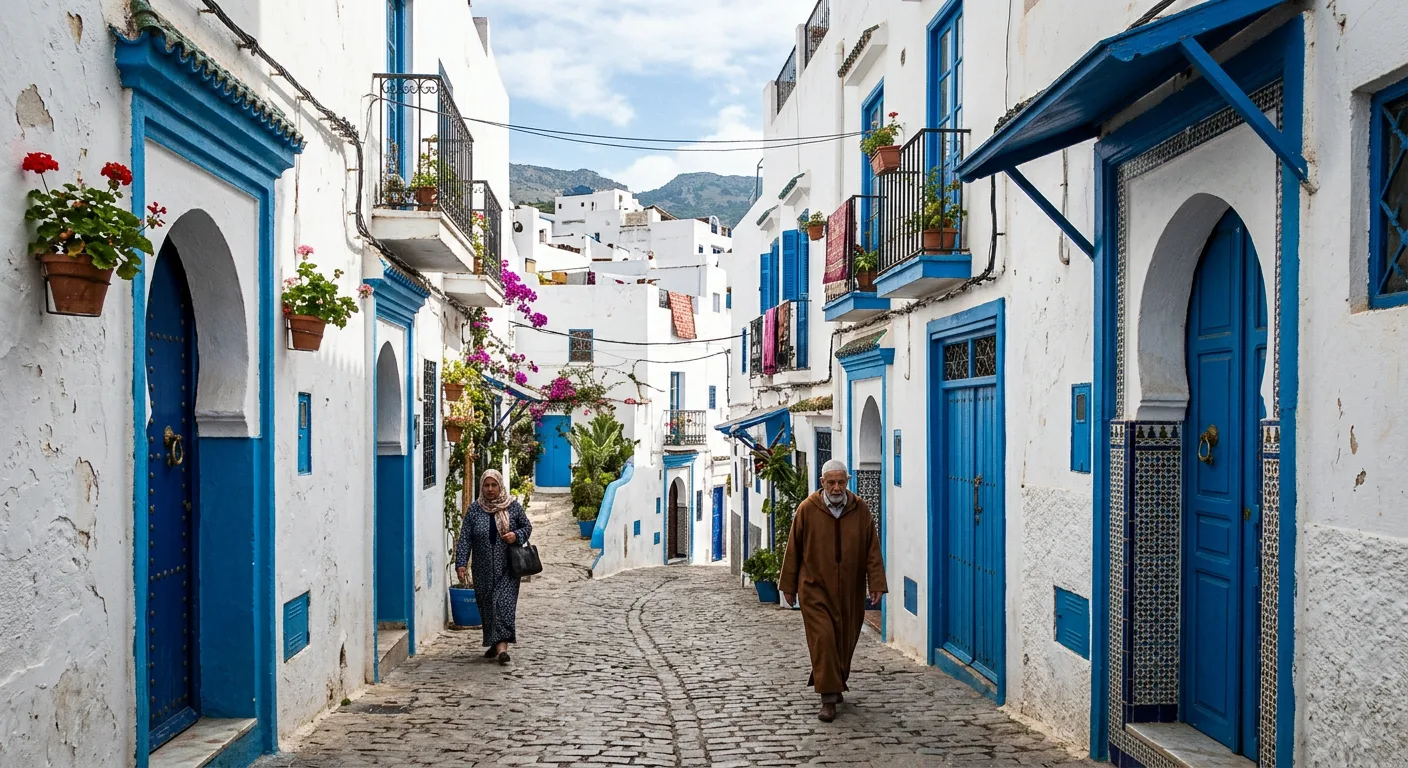
The short answer: yes, Tetouan is worth visiting — especially as an add-on to Chefchaouen. It sits about 65 km north of the blue city, roughly an hour's drive, and offers something Chefchaouen does not: a UNESCO-listed medina that is the most complete in Morocco, wrapped around a graceful Spanish colonial quarter. It is less polished and less photographed than its blue neighbour, which is exactly the point — this is a real, working Moroccan-Andalusian city. Below, what to see and exactly how to combine the two.
What makes Tetouan special
Tetouan was rebuilt from the 15th century by Muslim and Jewish refugees fleeing Andalusia after the fall of Granada. They brought Andalusian crafts, architecture and whitewashed houses, and the dense, pale old town they created earned the city its poetic nickname — the White Dove of the north. Its medina was inscribed by UNESCO in 1997 as the most complete and intact in Morocco: about 5 km of walls, seven monumental gates, and an interior largely untouched by outside influence. Then comes the twist — Tetouan was the capital of the Spanish Protectorate (1912–1956), so alongside the medina you get a European new town of plazas, cafés and art-deco façades found nowhere else in the country.
The best things to do in Tetouan
The medina is the main event — wander it rather than tick it off — but a handful of anchors give the day shape:
- The UNESCO medina & souks: working craft workshops, leather and textile lanes, and Andalusian courtyard houses, entered through ornate gates such as Bab Okla.
- Place Hassan II & the Royal Palace: the grand square where the medina meets the new town, framed by the mechouar of the royal palace.
- Dar Sanaa (the artisan school): opposite Bab Okla, where young craftspeople learn zellige, woodwork and embroidery.
- The Archaeological Museum: Roman mosaics and finds from the nearby ruins of Tamuda and Lixus, plus Phoenician and Jewish artefacts.
- The Spanish Ensanche: Place Moulay el Mehdi, the former cathedral and 1930s buildings — coffee and crepes in a corner of Morocco that feels briefly like southern Spain.
How to get there from Chefchaouen
Tetouan is one of the easiest excursions from the blue city — about 65 km, 1 to 1.5 hours through the Rif foothills. Shared grand taxis leave frequently and cheaply from the edge of Chefchaouen's new town, and CTM and local buses run the route too. A private driver is the most flexible choice if you want to add the coast or set your own pace. For the full picture of buses, shared taxis and timings in this corner of the Rif, see getting to and around Chefchaouen, and the full destination notes on the Tetouan destination guide.
Day trip, or a stop on the drive?
There are two clever ways to fit Tetouan in. The first is a half-day or day trip from Chefchaouen: leave mid-morning, give the medina and the Spanish quarter three or four hours, and be back for sunset at the Spanish Mosque. The second — and the most efficient — is to treat it as a stop on the Tangier–Chefchaouen drive, since Tetouan sits almost exactly between the two. Coming from Tangier, break the journey here for a couple of hours before continuing up to the blue city. It pairs naturally with our Chefchaouen day trip from Tangier.
Tetouan and the Mediterranean coast
Tetouan is also the gateway to the nearest stretch of Mediterranean. Within 15–40 minutes you can be on the sand at Martil, M'diq or Cabo Negro, or further along the wilder cliffs toward Oued Laou. History buffs can also detour to the Roman ruins of Tamuda just outside town. Combine the medina with a beach lunch and you have a full, varied day out that most blue-city visitors never realise is within reach. For the ranked list of excursions and honest drive times, see the best day trips from Chefchaouen.
So, Tetouan or Chefchaouen?
Do both. Chefchaouen is the prettier, slower, mountain town built for wandering and photographs; Tetouan is bigger, busier and more authentic, with deeper history and that singular Spanish overlay. Base yourself in the blue city for the atmosphere, then give Tetouan a half day to a full day for living culture over postcard looks. If you are still weighing up whether the wider region earns your time, our piece on whether Chefchaouen is worth it and what's around it sets the whole northern picture in context.
Frequently asked
Is Tetouan worth visiting?
Yes — if you like working, lived-in medinas more than polished tourist ones. Tetouan has a UNESCO-listed old town (inscribed in 1997) that is the most complete and intact in Morocco, ringed by about 5 km of walls with seven gates, and almost untouched by mass tourism. Layered on top is a rare Spanish side: a graceful colonial Ensanche of plazas and art-deco façades from the protectorate years. It is not as instantly photogenic as Chefchaouen, but it is more authentic, and barely an hour away — which makes it one of the best add-ons to a blue-city trip.
How far is Tetouan from Chefchaouen and how do you get there?
Tetouan is roughly 65 km north of Chefchaouen — about 1 to 1.5 hours by road through the Rif foothills. Shared grand taxis run the route frequently and cheaply from the edge of Chefchaouen's new town, and there are CTM and local buses too. A private driver is the most flexible option, especially if you want to carry on to the Mediterranean coast afterwards. Tetouan also sits almost exactly between Tangier and Chefchaouen, so many people visit it as a stop on the drive in or out rather than a separate trip.
Can you do Tetouan as a day trip from Chefchaouen?
Easily. With only about an hour each way, a half-day or full-day trip works well: leave mid-morning, spend a few hours in the medina and the Spanish quarter, and be back in the blue city for sunset at the Spanish Mosque. The medina is compact enough to see its highlights — the souks, the Royal Palace square, the artisan school and the Archaeological Museum — in three or four hours. If you also want the coast at Martil or M'diq, make it a full day with a driver rather than relying on shared taxis.
What is there to do in Tetouan?
The heart of it is the UNESCO medina: a dense, whitewashed maze of working souks, craft workshops and Andalusian houses, entered through ornate gates like Bab Okla. Don't miss the Royal Palace mechouar on Place Hassan II, the artisan school (Dar Sanaa) opposite Bab Okla, and the Archaeological Museum with Roman mosaics and finds from nearby Tamuda and Lixus. Then cross into the Ensanche — the Spanish-built new town around Place Moulay el Mehdi — for cafés, the former cathedral and 1930s architecture you won't see anywhere else in Morocco.
Why is Tetouan called the White City or White Dove?
Tetouan was rebuilt from the 15th century by Muslim and Jewish refugees fleeing Andalusia after the fall of Granada, who brought Andalusian architecture, crafts and whitewashed houses with them. That pale, tightly packed medina earned it the poetic nickname 'the White Dove' of the north. Later it became the capital of the Spanish Protectorate (1912–1956), which is why it wears a second, European layer — Spanish street plans, plazas and art-deco buildings — that sets it apart from Fes, Marrakech and even nearby Chefchaouen.
Is Tetouan or Chefchaouen better?
They do different jobs, so see both if you can. Chefchaouen is the prettier, calmer, mountain town built for slow wandering and photographs. Tetouan is bigger, busier and more authentic — a real Moroccan-Andalusian city where tourism is incidental, with deeper history and that unique Spanish overlay. For a first northern trip, base in Chefchaouen for the atmosphere and give Tetouan half a day to a day. If you want living culture over postcard looks, Tetouan rewards the curious traveller more than its quiet reputation suggests.
Is Tetouan safe and easy to visit?
Tetouan is generally safe and welcoming, with the usual city-medina caveats: keep an eye on your belongings in crowded souks and expect the occasional would-be guide offering directions. The medina lanes are genuinely labyrinthine and far less signposted than Chefchaouen's, so a licensed local guide for an hour or two is well worth it to get the most from the place and avoid backtracking. Dress modestly as you would anywhere in northern Morocco, and carry cash, as cards are rarely accepted in the old town.
Add the White City
We'll fold Tetouan into your blue-city trip.
A medina morning, a Spanish-quarter lunch, or a stop on the way in from Tangier with the coast added on — tell us your dates and we'll build Tetouan into your northern Morocco route at the right pace.
Request an itinerary