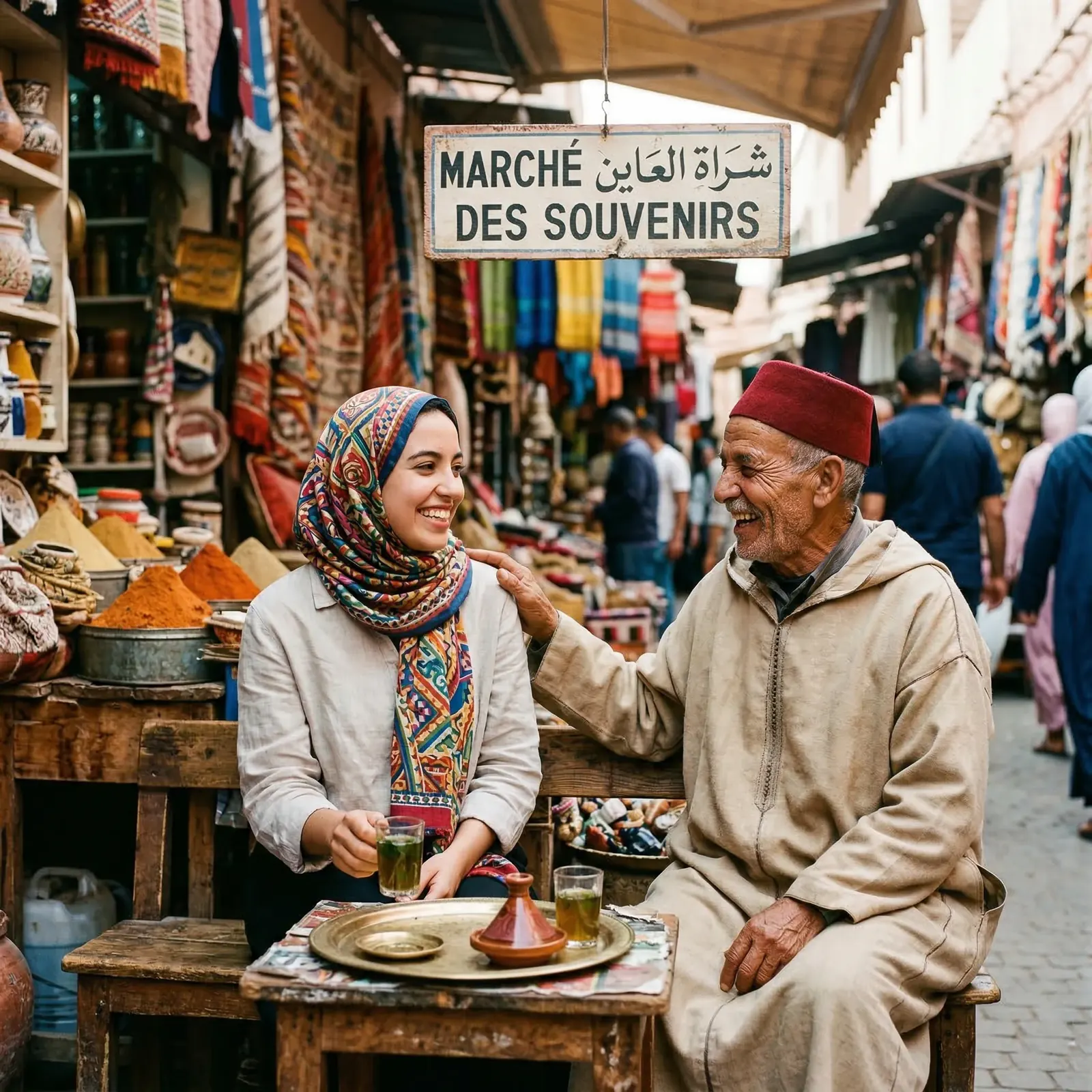
Chefchaouen does not cook to impress. Tucked into the Rif mountains, far from the coast and far from the grand kitchens of Marrakech or Fes, the blue city eats the way mountain towns eat everywhere — simply, freshly, and close to what the hills give. This is not a seafood town, and it is not the place for elaborate national showpieces. It is a place of fresh goat cheese sold by the round, of fava-bean soup on a cold morning, of olives and olive oil pressed nearby, of honey and nuts and warm bread. Here is what to look for, and where the pleasure really lies.
Jben — the goat cheese that is pure Chefchaouen
If one food belongs to Chefchaouen, it is jben — the fresh white goat cheese made in the Rif villages around the city. It is young and unaged: soft, a little crumbly, mild with a faint tang, nothing like the hard cheeses of Europe. You will see it stacked in small rounds in the medina market, sometimes wrapped in palm or fig leaves, sold straight from the makers who carried it down from the hills. Locals eat it at breakfast with bread, a drizzle of olive oil and a spoon of honey, or fold it through a simple salad. Buying a round from a market seller, then eating it on a terrace, is about as Chefchaouen as a meal gets.
Bissara — the northern fava-bean soup
Bissara is the soup of the north, and a true Rif breakfast. Dried, peeled fava beans are simmered soft and blended smooth, then finished at the table with a generous pour of olive oil, a dusting of cumin and a pinch of chilli. It is cheap, warming and deeply filling — a workers' dish, eaten with torn bread, and exactly what the cool mountain mornings of Chefchaouen ask for. Small family eateries and breakfast stalls ladle it out from early; in winter, a bowl of bissara and a glass of mint tea is a complete and very local start to the day.
Goat tagines and Rif produce
Meat here means the mountains: goat-meat tagines, slow-cooked with preserved lemon, olives and whatever the season brings, are the heart of a proper sit-down meal. Around them sits the produce of the Rif — tomatoes and peppers, fresh herbs, lentils and pulses, and the small cured olives the region presses into its own grassy olive oil. Vegetable tagines are everywhere and excellent, which makes the blue city an easy place to eat well without meat. Our guides know which kitchens to trust.
Honey, nuts and the morning bread
The Rif is honey country, and mountain honey — sold in jars in the medina — turns up at breakfast alongside local nuts, fresh goat cheese and, above all, bread. Moroccan bread is treated with respect across the country, and in Chefchaouen the communal oven still bakes the dough families carry to it each morning. Warm, torn by hand, used to scoop soup and oil and honey, it is the backbone of every meal here.
Kalinte — the Spanish-Andalusian legacy
Northern Morocco carries a strong Andalusian and Spanish thread through its history, and you taste it on the street as kalinte (also written calentita): a baked flan of chickpea flour, soft and savoury, cut into squares and eaten warm. It is a snack of the north — a small, telling reminder that Chefchaouen looks toward Spain across the strait as much as toward the rest of Morocco. That same lightness runs through the whole northern table and sets it gently apart from the cooking of the south. Read our full guide to the blue city.
Mint tea on a blue terrace
No meal in Chefchaouen really ends without mint tea — gunpowder green tea steeped with fresh spearmint and sugar, poured from height to froth it. The ritual is the same across Morocco, but the setting here is the thing: a terrace cafe above the washed-blue lanes, the medina falling away in shades of indigo below, the Rif mountains beyond. Plaza Uta el-Hammam, the main square under the kasbah, is ringed with terraces made for exactly this — a slow glass, a slow afternoon, the calm that gives Chefchaouen its name among travellers. We build slow, food-led days into our private tours.
Frequently asked
What food is Chefchaouen known for?
Chefchaouen's signature is its fresh local goat cheese (jben) — soft, white and lightly tangy, made in the surrounding Rif villages and sold by the round in the medina. Beyond that, the city's table is mountain cooking: bissara (a thick fava-bean soup eaten with bread, olive oil and cumin), goat-meat tagines, Rif olives and olive oil, mountain honey and nuts, and abundant fresh bread. This is not a seafood town and it is not about elaborate national showpieces — it is calm, simple, fresh food shaped by the hills around it.
What is jben, the Chefchaouen goat cheese?
Jben is a fresh, soft white cheese made from goat's milk (sometimes mixed with cow's) in the villages of the Rif around Chefchaouen. It is young and unaged — mild, faintly tangy, a little crumbly — and you will see it stacked in small rounds, often wrapped in palm leaves, in the medina market. Locals eat it at breakfast with bread, honey and olive oil, or fold it through a salad. Buying a round straight from a market seller is one of the simplest, most Chefchaouen things you can do.
What is bissara and where do you eat it?
Bissara is a thick soup of dried, peeled fava beans (sometimes split peas), blended smooth and finished with a generous pour of olive oil, a dusting of cumin and a pinch of chilli. It is a northern Moroccan staple and a true workers' breakfast — cheap, warming and filling, eaten with torn bread on cold Rif mornings. Small family eateries and breakfast stalls in and around the medina serve it from early; in winter it is exactly what the mountain air calls for.
Is there a Spanish influence on Chefchaouen's food?
Yes. Northern Morocco — Chefchaouen included — carries a strong Andalusian and Spanish legacy from its history. You taste it in kalinte (also spelled calentita), a baked chickpea-flour flan that is a street snack of the north, and in the general lightness of the cooking. The Spanish thread runs through the whole region, and it gives the northern table a slightly different character from the cooking of Marrakech or Fes.
Is Chefchaouen good for vegetarians?
Very. Mountain cooking here leans naturally on vegetables, pulses and dairy. Bissara is vegetarian, as is much of the produce-driven cooking — tomato and pepper salads, lentils, fresh goat cheese, olives, bread and olive oil, honey and nuts. Vegetable tagines are easy to find, and a breakfast of jben, bread, honey and mint tea needs no meat at all.
Where should you eat in Chefchaouen?
The pleasure here is the setting as much as the plate: small family-run eateries tucked into the blue lanes, and terrace cafes that look out over the medina's washed-blue rooftops. Plaza Uta el-Hammam, the main square below the kasbah, is ringed with terraces ideal for a slow tagine or a glass of mint tea. We point guests toward the simple, honest kitchens locals use rather than anywhere chasing the tourist trade — and we won't invent names or prices we can't stand behind.
Eat like you live here
Our private days reach into the medina market, the family kitchens and the terraces locals love.
Chefchaouen Blue City Tours arranges slow, food-led mornings in the blue city — from buying jben straight off the market to a bowl of bissara and a long glass of tea above the lanes — for guests who want to taste the Rif, not just photograph it.
Enquire about a food experience